The following article is from 联合国教科文组织 Author BEJ/CLT

联合国教科文组织.
联合国教科文组织建立于1945年,使命为“于人之思想筑起保卫和平的屏障”。
“下一个50年”水遗产促进城市可持续发展研讨会在杭州召开
(English version below)

2023年6月9日,作为联合国教科文组织1972年《保护世界自然和文化遗产公约》50周年全球庆典的一部分,“下一个50年:水遗产促进城市可持续发展”专题研讨会在京杭大运河畔拉开帷幕。海内外遗产和环境专家、地方政府代表、城市规划者和青年齐聚于此,共同探讨城市中水作为遗产的重要作用,并寻找进一步利用这些自然和文化遗产加强城市环境、社会和经济韧性,创新应对当前和未来挑战的机会。
联合国教科文组织亚太地区世界遗产培训与中心(北京)主任助理、北京大学考古文博学院李光涵博士主持研讨会第一场会话——“水与文化景观”,并做主旨演讲。
开幕式
会议伊始,杭州市人民政府副市长孙旭东先生、联合国教科文组织驻华代表处代表夏泽翰教授以及奥地利驻华大使馆文化处、科技处主管公使满昊宸先生作了开幕致辞。

杭州市人民政府副市长孙旭东发表致辞
作为历史文化名城,杭州有三大列入世界遗产名录的文化景观——杭州西湖文化景观(2011年)、大运河(2014年)和良渚古城遗址(2019年),其中有两处为中国水遗产的杰出代表。孙旭东副市长分享了遗产地管理的“杭州经验“,例如践行世界文化遗产免费开放的西湖模式,打造大型线性活态遗产保护利用的运河样板,探索大遗址保护融入经济社会发展的良渚方案,积极推动三大世界文化遗产的保护、传承、利用和研究。

联合国教科文组织驻华代表处代表夏泽翰教授发表致辞
夏泽翰教授高度认可杭州在保护水遗产方面的杰出实践,他期待此次研讨会以及与教科文的合作可以加强杭州通过保护水遗产以促进可持续发展的能力,打造一个全球水遗产保护之都。

奥地利驻华大使馆文化处、科技处主管公使满昊宸先生发表致辞
满昊宸先生分享了水在奥地利世界遗产地中的角色。在他看来,本次研讨会提供了一个国际知识和经验共享的平台,这对于水和遗产的保护至关重要。
研讨会聚焦以下四个主题:
·水与文化景观
·历史名城的水治理
·水的创新与创造力
·城市可持续发展:水与遗产相结合
会话1 水与文化景观

会话1的主持人,北京大学考古文博学院的李光涵博士以题为“水与文化景观:水在定义我们与景观关系中的作用”的演讲拉开了研讨会的帷幕。她提出应将水遗产的保护嵌入可持续景观中,结合其生物价值与精神价值,注重集水区的连通性,并进一步引出本次会话中要讨论的两个主要问题:在亚太地区的景观管理和遗产保护中,有哪些解决与水有关的紧迫问题的成功案例?我们如何弥合遗产和水资源管理专业人员之间的差距以制定一个合作框架?

李光涵博士发表主题演讲
浙江大学刘朝晖教授介绍了他对中国大运河船民的研究,以及如何从船民的经验智慧中学习与水有关的知识。
与文化遗产保护、教育、战略规划、培训师游慧女士以及西交利物浦大学金俊植教授一起,与会嘉宾就亚太地区景观管理和遗产保护方面与水有关的问题以及以及可行的解决方案展开讨论。小组亦讨论了如何弥合水资源管理和保护相关部门之间的差距,提出了基于景观、基于地点和以人为本的方法,并强调了建立伙伴关系和多边对话的重要性。
会话2 历史名城的水治理

来自澳门旅游学院的谢里夫·沙姆斯·伊曼博士的演讲探讨了水在塑造人类文明中的历史意义,以及它在当代城市中的作用。他强调有必要将水与历史城市居民的生活重新联系起来。来自浙江省文物考古研究所的张书恒女士以西兴镇为例,展示了了解传统水基交通系统及其相关人居环境对做出更好的保护决策的重要性。
在由东南大学董卫教授、世界银行集团黄晓丹女士和张书恒女士参与的小组讨论中,与会代表就如何为历史城市的未来管理水资源分享了不同但又互补的观点。讨论得出,水和城市是一个动态的大系统的一部分,必须在区域一级采取综合、多维的办法,将传统知识与现代技术有机结合。同时,专家和社区之间的知识分享和能力建设是保证有效执行的关键。
会话3 水的创新与创造力
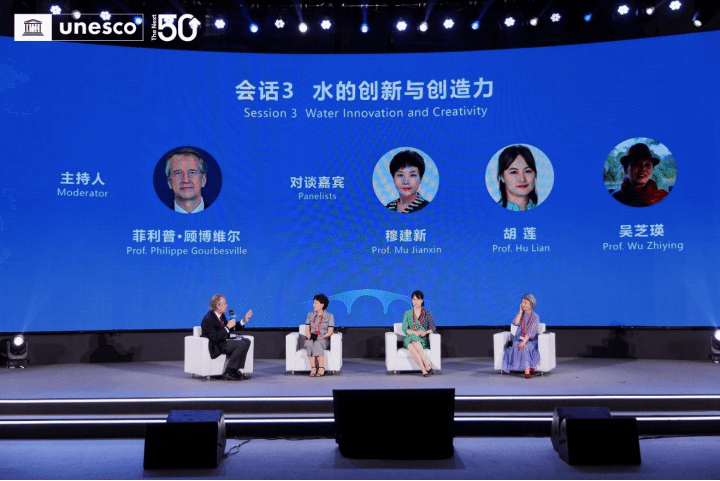
尼斯索非亚综合理工学院水正教授菲利普•顾博维尔厘清了讨论的重点—“到底什么是创新”?就这个问题,菲利普•顾博维尔分享了法国、韩国、印尼的优秀实践。原杭州西湖水域管理处副主任吴芝瑛分享了杭州长桥溪水生态修复公园“水的复活”;天津大学副教授胡莲介绍了大运河天津段在杨柳青镇的创新工程;联合国教科文组织顾问穆建新分析了北京市房山区湿地恢复生态水文解决方案。在讨论环节,与会嘉宾就各自案例中的良好实践如何能够应用在更广的领域之中作了更为深入的剖析。嘉宾们认为实现创新需要一个全局性的视角,应对社会不同方面的问题,以找到一个可持续的管理模式。
会话4 城市可持续发展:水与遗产相结合

来自宁波诺丁汉大学的陈加信副教授率先分享了一系列杭州和宁波著名的古代水利基础设施。这些例子开启了关于城市可持续发展“转型“的讨论,以及我们如何充分利用这些中国古代水利基础设施来应对诸如城市化、气候变化等当前和未来的挑战。来自中国水利水电科学研究院的李娜博士、武汉大学的罗玉峰教授、浙江大学的董丹申教授以及良渚古城遗址世界遗产监测管理中心的孙海波主任参与了讨论。嘉宾们指出“我们应该保持这些基础设施的活力”—— 通过立法和规划保留和利用这些基础设施,维护这些宝贵的遗产。同时,包括民间社会和社区在内的利益攸关方应共同努力,将这些基础设施传承给下一代。
本次研讨会为未来水遗产管理提出了更多可能性,并为不同领域的专家、部门和利益攸关方之间的合作开辟了机会。联合国教科文组织和杭州市政府将共同探索未来的机会,向更广泛的受众介绍杭州的经验,并共同应用从研讨会上学到的国际经验,以提高这座美丽城市水遗产的管理和价值。

“The Next 50” Symposium on Water Heritage for City’s Sustainable Development
On 9 June 2023, within the framework of “The Next 50” global celebration of the UNESCO 1972 Convention concerning the Protection of the World Cultural and Natural Heritage and in collaboration with Hangzhou Municipal Government, UNESCO Multisectoral Regional Office for East Asia successfully organized the Symposium on Water Heritage for Cities’ Sustainable Development. Bringing together experts, professionals and managers from diverse expertise and sectors, the symposium explored the role of water as heritage in cities – especially historic cities and settlements – and identified opportunities to further utilize this natural and cultural heritage to address ongoing and emerging challenges. The symposium’s speakers and panelists also discussed innovative approaches to integrate water heritage into larger climate and environmental efforts in the year to come to strengthen the cities’ environmental, social and economic resilience.
Dr. Li Kuanghan, Assistant Director of World Heritage Institute of Training and Research for the Asia and the Pacific Region under the auspices of UNESCO (Beijing) from School of Archaeology and Museology of Peking University, moderated the first session of the workshop(Water and Cultural Landscape) and presented a keynote speech on the subject.
Opening Ceremony
Vice Mayor of Hangzhou Municipal Government, Sun Xudong, Director of UNESCO Multisectoral Regional Office for East Asia, Shahbaz Khan, and Head of the Austrian Cultural Forum Beijing, Christian Mandl delivered opening remarks.
Mr. Sun Xudong shared “Hangzhou experience” in the management of three World Heritage sites – West Lake Cultural Landscape of Hangzhou (2011), The Grand Canal (2014) and Archaeological Ruins of Liangzhu City (2019) – with the two of them representing outstanding water heritage of China. Hangzhou is committed to work together with different social groups to protect cultural diversity and biodiversity for sustainable development.
Prof. Shahbaz Khan highly recognized Hangzhou’s great achievements in water heritage preservation, and he believed that the gathering of water and heritage experts through UNESCO’s collaboration with Hangzhou can further strengthen Hangzhou’s capacity in building a “World Water Capital”.
Mr. Christian Mandl shared the role of water in Austrian World Heritage properties, and he believed that the symposium can build an international platform for encounters and offer a good opportunity to exchange experiences and commonalities and to serve as a model for other cities.
The symposium shed light on the following four themes:
·Water as cultural landscapes
·Managing water in historic cities
·Water innovation and creativity
·Integrating water and heritage for cities’ sustainability
Session 1: Water as cultural landscapes
The moderator of the panel, Dr. Kuanghan Li from UNESCO Category 2 Center WHITRAP-Beijing and Peking University School of Archaeology and Museology, opened with a keynote speech to introduce the role of water in defining landscapes and how to embed water heritage into sustainable landscape conservation and management. She suggested that water heritage conservation should be embedded into sustainable landscapes, combining its biological values with spiritual ones and focusing on connectivity in the catchment area. She further led to the two main questions to be discussed in this session: What are the successful examples in addressing the issues related to urgent water-related issues in landscape management and heritage protection in the Asia-Pacific region? How do we bridge the gap between heritage and water management professionals to develop a collaborative framework?
Prof. Chaohui Liu from Zhejiang University presented his research on the boat people of the China’s Grand Canal and how we can learn from their experiences and wisdom on water-related knowledge.
Together with Ms. Anna Yau, independent conservationist from Hong Kong, and Prof. Joon Sik Kim of Xi’an Jiaotong-Liverpool University, the panelists discussed water-related issues in landscape management and heritage protection specific to the Asia and Pacific region, and examples of viable solutions and case studies. The panel then concluded with the discussion on how to bridge the gap across water resource management and conservation related sectors, and proposed landscape-based, placed-based and human-centric approaches. The discussion also emphasized the importance of partnership building and multilateral dialogues.
Session 2: Managing water in historic cities
The session began with two keynote speeches. Dr. Sharif Shams Imon of Macao Institute for Tourism Studies – the panel’s moderator – kicked off the session with a presentation that explored the historical significance of water in shaping human civilizations, as well as its role in contemporary cities. He emphasized the need to reconnect water with the lives of residents in historic cities, as the disassociation of water from daily life has had a negative impact. Ms. Zhang Shuheng from Zhejiang Institute of Cultural Relics and Archeology showcased the importance of understanding traditional water-based transport systems and their associated human settlements in making better conservation decisions, using Xixing Town as an example.
During the discussion, also joined by Prof. Dong Wei of Southeast University and Ms. Huang Xiaodan from the World Bank Group, different but complementary views were shared on how to manage water for the future of historic cities. It was concluded that water and cities are part of a dynamic and large system, and an integrated and multi-dimensional approach at a regional level, based on traditional knowledge but utilizing current knowledge and technology, is necessary. Knowledge sharing and awareness raising between professionals and communities were emphasized as crucial for effective implementation.
Session 3: Water innovation and creativity
The focus of the discussion, according to Prof. Philippe Gourbesville from the Polytech Nice Sophia, was “what exactly is innovation?”. To respond the question, Prof. Gourbesville shared examples of good practices of France, South Korea and Indonesia. Ms. Wu Zhiying (Former Director of Hangzhou West Lake World Cultural Heritage Monitoring and Management Center) shared the case of “Water Revival” by Hangzhou Changqiao Stream Eco-Restoration Park. Dr. Hu Lian (Associate Professor of Tianjin University) introduced the innovative project of the Tianjin section of the Grand Canal in Yangliuqing Town. Lastly, Dr. Mu Jianxin (Consultant of UNESCO) analyzed eco-hydrological solutions for wetland restoration in Fangshan district, Beijing. During the discussion session moderated by Prof. Gourbesville, the panelists gave a more in-depth analysis of how good practices in their cases can be applied to a wider range of fields. Panelists agreed that innovation requires a holistic perspective that addresses different aspects of society in order to find a sustainable management model.
Session 4: Integrating water and heritage for cities’ sustainability
The session was initiated by Dr. Faith Chan (from University of Nottingham Ningbo China)’s keynote speech with an in-depth analysis of ancient water infrastructure in Hangzhou and Ningbo. These examples opened up the discussion about the “transformation” on the city’s sustainable development and how to address current and future challenges such as urbanisation and climate change by leveraging these treasurable ancient Chinese water infrastructures. Prof. Li Na from China Institute of Water Resources and Hydropower Research, Prof. Luo Yufeng from Wuhan University, Prof. Dong Danshen from Zhejiang Univeristy and Mr. Sun Haibo from Liangzhu World Heritage Management Centre participated in the discussion. The panelists believed that “we should keep these infrastructures alive”. Since most of infrastructure are still in active use nowadays, it’s important to preserve these valuable heritages through legislation and urban planning. At the same time, stakeholders including civil societies and communities should co-produce and work together to embrace these infrastructures and extend its value to the next generations.
The symposium suggested many possible topics for future interventions and opened up many opportunities for collaboration, among experts from different fields, among stakeholders from different sectors. UNESCO and Hangzhou will explore future occasions to introduce Hangzhou experiences to wider audiences, and work together to apply the international experiences learned from the symposium to enhance the management and values of water heritage in this beautiful city.