The “Youth Heritage Alliance” was initiated by the UNESCO Asia-Pacific Heritage Training and Research Institute for World Heritage (Beijing).
Along with the global expansion of the heritage conservation movement, heritage studies today have become highly interdisciplinary. We hope to use this diversity, openness, and spirit of breakthrough to invite scholars from different academic backgrounds to exchange ideas and perspectives, allowing young scholars to inherit the traditions of their disciplines while also developing innovative viewpoints and the courage to break boundaries.
Theme
Innovation and Ethics in Intangible Heritage
Moderator
Li Guanghan
Guests
Wu Jie, Zhou Zhenzheng, Philipp Demgenski
Time and Location
March 25, 2023
WHITRAP-Beijing
Participants
【Offline】
Li Guanghan, Li Ang, Xie Li, Philipp Demgenski,
Wang Siyu, Wu Jie, Zhang Lisheng, Luo Pan, Duan Niudou, Zhou Zhenzheng,
Wang Yuchen, Du Lindong, Cai Shiyu, Li Ruikang, Zheng Zhaoqi
【Online】
Sun Jing, Sun Lina, Li Jin, Li Hanchun, Wang Shaohan
Ordered according to speaking sequence
Participant biographies are listed at the end of the article.
▼
Abstract
The moderator shared domestic and international case studies related to innovation and exhibitions involving intangible cultural heritage (ICH), analyzing differences between Chinese and international understandings of the concept of ICH, and introducing ethical issues encountered in practical work related to ICH. The moderator later shared experiences from the Dali Women’s Textile Cooperative in Guizhou and discussed ICH-related issues arising from that practice. Salon participants discussed topics including the meaning of intangible cultural heritage, artistic creation, cultural ownership, ethics, and law.
Keywords
Intangible Cultural Heritage; Ethics; Art; Innovation; Practice
Discussion Topics
The meaning of intangible cultural heritage
Cultural ownership, artistic creation, ethics, and law
Dong cloth practice and related issues in Dali
▲
The Meaning of Intangible Cultural Heritage
Li Guanghan:
Our salon rarely discusses intangible cultural heritage, but in practice we have all realized that material and intangible heritage cannot truly be separated into a strict binary. I think that is why this discussion is necessary.
In China, intangible heritage is often combined with innovation, even producing terms such as “ICH cultural creative transformation.” Internationally, however, “creative industry” and “intangible cultural heritage” are rarely discussed together. In fact, the differences between China and international practice reveal two issues. First, how should ICH be connected with commerce and the market? Second, how should ICH be developed, designed, and managed? These are all forms of intervention into ICH.
To what extent should the concept of ICH be expanded? Is a family or ethnic group’s cultural symbol itself ICH? Or is the creation of cultural symbols, such as embroidery techniques, considered ICH? Or do innovations based on these techniques also become ICH? Once innovation is involved, copyright and related issues emerge. This involves many different layers of discussion.
Li Ang:
In China today, many ICH projects are closely connected with products. The 2003 UNESCO Convention for the Safeguarding of the Intangible Cultural Heritage defines “intangible cultural heritage” as “the practices, representations, expressions, knowledge, skills — as well as the instruments, objects, artifacts and cultural spaces associated therewith — that communities, groups and, in some cases, individuals recognize as part of their cultural heritage.”
The core idea is actually the safeguarding of ICH skills and techniques at different levels and promoting their transmission. That was UNESCO’s original intention. From the implementation and feedback surrounding the Convention, excessive commercialization of ICH techniques has become a phenomenon worthy of attention, because it leads to commercialization and many intellectual property disputes.
But the problem is that without commercialization, many practitioners cannot survive. And intellectual property itself is a vague concept. The ICH Convention is ultimately only a soft form of regulation.
Xie Li:
Many of these issues existed from the very beginning of the ICH concept. Intangible heritage is often the spontaneous appreciation and transmission of traditions and practices important to a particular group, reflecting the vitality and agency of tradition itself.
How or whether ICH should be defined externally, whether the concept of “ICH” is even necessary, and how to protect and utilize it without damaging its vitality and authenticity — none of these issues are very clear. The rapid promotion of ICH in China also involves many practical factors.
Philipp Demgenski:
I once participated in a project called “UNESCO in Friction,” which studied how international conventions are discussed at UNESCO headquarters in Paris and what changes occur when they are implemented in countries at different stages of development. So what interests me is not what ICH is, but rather what it does and what changes it creates.
I think many people here today have negative feelings toward the term “ICH.” China’s understanding of ICH is completely different from UNESCO’s definition. At the official level, China emphasizes protection, preservation, and the excellence, preciousness, and authenticity of certain forms of ICH.
UNESCO, however, emphasizes community participation and reduces the authority of experts. Community participation is an important concept in the Convention for the Safeguarding of the Intangible Cultural Heritage. Therefore, within the Chinese context today, ICH has already undergone certain transformations.
Cultural Ownership, Artistic Creation, Ethics, and Law
Li Guanghan:
In the Chinese context, discussions about the living preservation of ICH inevitably involve innovation, and innovation inevitably raises ethical questions. In China, these issues often exist in a gray area and are ignored.
In Western discussions, the term “cultural appropriation” is often mentioned. So where exactly is the boundary between “cultural appropriation” and “cultural appreciation”? Usually, the difference lies in whether sufficient recognition is given to the source culture and source community.
At the same time, Western controversies over ICH are generally not about heritage itself, but about conflicts between different cultural groups — especially inequalities in power between marginalized or minority cultures and between nations.
A common example occurs in commercial design, when designers use cultural symbols from a certain ethnic group. That group may believe those symbols represent its culture and possess sacred meaning, and that only members of the group have the right to use them.
Concepts such as creative rights and copyright are very modern legal ideas. If mature modern legal concepts are applied to things that existed long before those laws, many problems emerge. Therefore, this is not simply a legal issue; ethical discussion is necessary.

▲ Left: Traditional clothing of Canadian Inuit Indigenous people
▲ Right: Clothing by a British fashion brand
The Inuit community protested the brand’s appropriation of their cultural symbols because the clothing represented shamanic symbols with sacred meanings.
Source: https://www.sohu.com/a/570025808_121124645

▲ Left: Embroidery patterns created by women from the Dali Dong Cloth Cooperative
▲ Right: Decorative patterns used in newly built houses in Dali Village
Some designers accused the cooperative’s work of stealing creative ideas. They claimed they were the first to place traditional patterns onto bags and therefore owned the creative rights, even though the patterns themselves were originally created by villagers.
This dispute involves ethical issues.
Source: Provided by Li Guanghan
A common form of Chinese ICH practice is turning traditional symbols such as paper-cutting into cultural products. Several key points arise here. First, many so-called “cultural creative” ICH products do not actually belong to a particular cultural group. Second, once something is labeled as ICH, it seems to receive official support.
With government involvement, do derivative products of ICH possess copyright or ownership? Is cultural appropriation occurring? Could this lead to conflict between ethnic groups?
Xie Li:
A small question: internationally, when cultural product designs involve huge commercial interests, are there intellectual property laws used to determine ownership?
Wu Jie:
Some ICH inheritors in China’s ethnic minority regions are already developing awareness of intellectual property rights. During my fieldwork in Kaili, Guizhou, I found that many Miao embroiderers apply for intellectual property protection for their embroidery works.
This phenomenon emerged because commercialization of Miao embroidery created economic value. But I also have doubts. Miao embroidery has been passed down through generations and represents collective wisdom. It is difficult to say it belongs to an individual.
However, some embroiderers have successfully obtained intellectual property rights for their works. In these works, the techniques are traditional, but the embroiderers added personal creativity through pattern use, color schemes, and composition.
While considering whether these intellectual property claims are reasonable, I also realized that ICH is alive and continuously evolving in daily life. Applying for personal patents is a commercial act through which embroiderers assert themselves as design subjects. Yet the patterns themselves are products of collective historical creation by a group. This creates a gray area in ethical discussions.
When observing how traditional Miao culture entered museum collections and how it was interpreted in exhibitions, I encountered a controversial exhibition called Shi Miao — Multidimensional Imagination of Miao Culture.
The exhibition used contemporary art methods to express Miao culture through innovative forms. One controversial installation was Gu. When viewers approached it, the installation vibrated unexpectedly. The artist believed this surprise represented “culture shock.”
However, “Gu” has long been a stigmatizing symbol that Miao people wish to escape.
The exhibition also displayed embroidery works created through collaboration between artists and embroiderers — using traditional embroidery techniques to express the artist’s concepts and patterns.
In the exhibition narrative, the artists portrayed the Miao as isolated people living in remote mountain regions who needed to break free from traditional constraints. Many Miao viewers felt the exhibition contained excessive imagination and could spread misinformation about Miao culture.
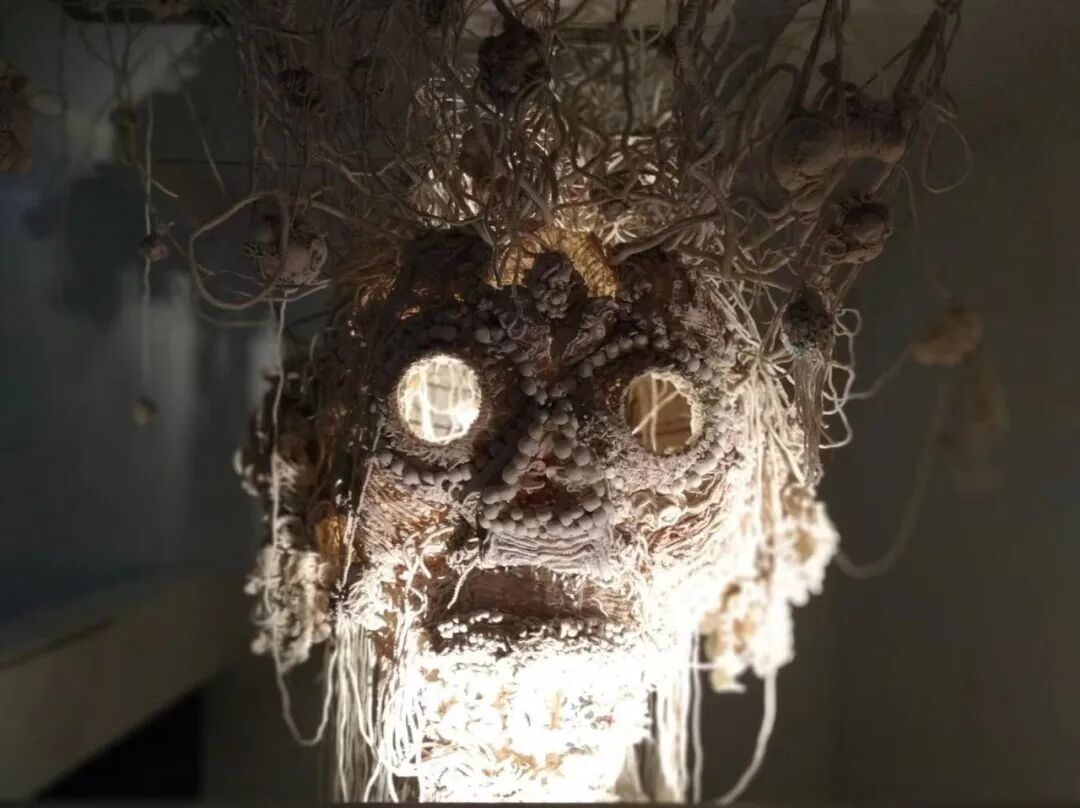
▲ The installation Gu from the exhibition Shi Miao — Multidimensional Imagination of Miao Culture
Source: Provided by Wu Jie
Speaking of Miao clothing, garments from Shidong in Taijiang, Guizhou often feature the “卍” symbol on the back collar.
The Miao embroiderers I interviewed believed it represented waterwheels or agricultural tools. However, some researchers interpret the symbol as a code connected to ancient Chinese civilization and a symbol of the origin of life.

▲ The “卍” symbol on Miao clothing
Source: Provided by Wu Jie
These examples show that in artistic creation, although artists borrow Miao embroidery techniques and clothing culture, those techniques and cultural elements become merely tools.
Researchers also believe that although embroiderers are inheritors of Miao embroidery, they no longer understand the deeper meanings embedded in Miao clothing related to life and the origins of civilization.
To some extent, both artists and researchers regard embroiderers merely as technical inheritors who know how to produce clothing. This involves issues of cultural power and may be considered a core ethical issue within ICH.
Li Guanghan:
One viewpoint argues that ICH focuses on transmitting techniques, so inheritors only need to preserve the craft while scholars study deeper meanings and sacred significance. It resembles a division of labor.
But if Miao embroiderers are excluded from both roles in an exhibition, they naturally end up in a disrespected position.
Zhang Lisheng:
The problem is that some artists in the Shi Miao exhibition approached Miao culture through the framework of their preexisting identities.
Luo Pan:
Some exhibitions ultimately present a top-down narrative of artistic creation, which inevitably creates ethical issues. Furthermore, these exhibitions are often supported by grant-funded projects that must prove the correctness and legitimacy of their actions, meaning they cannot remain purely artistic creations.
Duan Niudou:
Academic research requires precise definitions and expression, but art does not. Artistic creation sometimes pursues uncertainty, contradiction, drama, and conflict. Art can conceal parts of reality.
Except for commercial art, other forms of art are difficult to analyze rationally or quantitatively.
I think the exhibition mentioned reflects at least three issues:
First, we need to break away from existing assumptions and stop habitually viewing Miao culture through the lens of frontier ethnic minorities, even unconsciously.
Second, we need to reflect on the knowledge system created through ethnic classification — specifically how the boundaries and meaning of “Miao” are defined.
Third, we should return to understandings and identities that existed before ethnic classification systems were created.
Only by combining these approaches can we truly understand a group’s cultural symbols.
Li Guanghan:
I did not mention art in my introduction because I think artistic issues are more complicated than commercial products.
One of my views is that artists should maintain independent and free creation. Artistic creation may not need to overly consider ethical questions and can be imaginative and unrestricted.
However, in my previous work I found that Chinese artists who use ICH elements often connect their creations to political and ethical goals — for example, trying to promote a folk craft into officially recognized ICH. This may be a uniquely Chinese phenomenon.
Artistic creation itself should fundamentally be a bottom-up process centered on personal aesthetics. Once it is placed within a humanitarian framework and connected to grand ideals, problems emerge.
Wu Jie:
The artistic work discussed above was not purely free artistic expression. It was art based on an existing culture and directed toward a specific cultural community.
There was interaction and communication with cultural bearers during the artistic process, yet the final result expressed only one voice.
So where is the ethical boundary of creation?
Zhang Lisheng:
This is similar to writing ethnography. After finishing an ethnography, should researchers let the people being studied review it?
Duan Niudou:
If artistic expression is based on a specific culture but lacks understanding of that culture’s background, it becomes mere spectacle.
Therefore, I believe anthropology, art history, art criticism, and related fields need better platforms for interaction.
Luo Pan:
I think we must ask: where exactly is the boundary of ethics? Are there industries that do not require ethics? Why should artistic creation be exempt from ethical constraints?
Where does ethics apply, and is there a scientific way to apply it?
As we discussed earlier, ethical standards may differ between pure artistic creation and art created under grant-funded projects.
Perhaps there is no universal ethics in ICH issues at all — but then why discuss ethics in the first place?
I do not believe any profession, whether art or writing, can ignore ethics simply to achieve creative goals.
Dali Dong Cloth Practice and Related Issues
Zhou Zhenzheng:
The design project that Li Guanghan and I worked on in Dali began in 2015. We attempted to establish a women’s textile cooperative, which was not officially registered until 2021.
Now, when speaking publicly, I try to avoid describing this work as “intangible cultural heritage.” I do not think what we are doing in Dali is ICH work, and none of the participants are officially recognized ICH inheritors.

▲ Dali Women’s Textile Cooperative
Source: Provided by Zhou Zhenzheng
The original purpose of the project was to explore the origins of Liang cloth production techniques and how this culture and production process are transmitted.
Although Dali Village has no officially recognized ICH inheritors, it has preserved a very complete traditional Dong lifestyle.
Dong dyeing, weaving, and handwoven cloth are closely related to women’s identity and sun-and-moon worship.
Li Guanghan and I strongly oppose calling the cooperative’s products “cultural creative products.” We are not trying to create a commercial brand.
Our fundamental goal is to guide local women in creating new things — to provide training and empowerment through innovation in Dong cloth techniques.
Over many years, we developed relationships and emotional connections with local women. From the original three participants, one leader emerged. She is under forty years old, a mother of three children, and she and her husband chose to stay in the village to raise their children.
She participated in our project from the beginning and is now the legal representative and production manager of the cooperative. She genuinely wants to continue this work, so we continue supporting her.
In many ways, this process resembles women’s entrepreneurship.
Li Guanghan:
We also never describe our work as an “ICH protection project” or “ICH innovation project.” I believe Dong cloth production is simply one form of traditional knowledge within Dali Village.
Once we define it as ICH, we must then define what exactly should be protected — the polished cloth technique? Indigo dyeing? Or something else?
We do not want to become trapped in defining ICH. Therefore, in our work we have not interfered with the original weaving and dyeing system in Dali. We hope this system can continue growing naturally without excessive intervention.
To some extent, if Dong weaving and dyeing techniques truly become endangered, I would even question whether they necessarily need to be protected.
You could understand our work as community-based practice. The Dong cloth system remains relatively complete and connected to a broader social and cultural context.
Our purpose is to help this practice continue and remain ordinary and widespread, rather than turning it into something “special” or “representative” in the ICH sense.
Zhou Zhenzheng:
Our product designs are open-source. We are not developing a brand or pursuing commercial exclusivity, so we do not care about exclusive IP ownership.
We actively encourage local people to design products using Dong cloth. Some strong designs are incorporated into our product catalog.

▲ A cushion designed independently by local women using Dong cloth
Source: Provided by Zhou Zhenzheng
We also participate in a tourism project in Dali, but our focus is heritage education and how local culture can continue to be passed down.
Therefore, we began systematically documenting elderly women’s handwoven ribbon techniques, restoring traditional Dong soybean dyeing techniques, and creating products and experiential workshops.
 ▲ Restoration of soybean dyeing techniques
Source: Provided by Zhou Zhenzheng
Although we consistently emphasize sharing designs, resources, and profits with local women, implementing these ideas remains difficult. Not all women fully understand these concepts.
Most local women are primarily concerned with how much they can earn for making a product and have limited understanding of the market, so conflicts frequently arise.
Li Guanghan:
The difficulties encountered by the Dousa Studio manager in Dali are quite typical.
The manager is relatively young and completed high school education, making her more suitable than older illiterate women for communication with the outside world.
But this involves moving away from a society based on kinship and personal relationships. She must manage people and work regardless of age hierarchy, which created many difficulties in the beginning.
Furthermore, many local women initially believed this project was simply something we were financially supporting, meaning they would receive money regardless of results. Therefore, there was initially a lack of initiative and little understanding that the project’s sustainability depended on their own participation.
Luo Pan:
What would happen if you completely stepped back and left the local women alone?
Zhou Zhenzheng:
Our relationship with the local women is not simply employment.
We provided all the resources available to us. Whether they can complete the orders we bring entirely depends on the women themselves.
If they succeed, the cooperative can make money and no longer depend on foundation support. The cooperative could operate independently.
As Li Guanghan mentioned earlier, the Dali project should be understood as a case of community work rather than a commercial project.

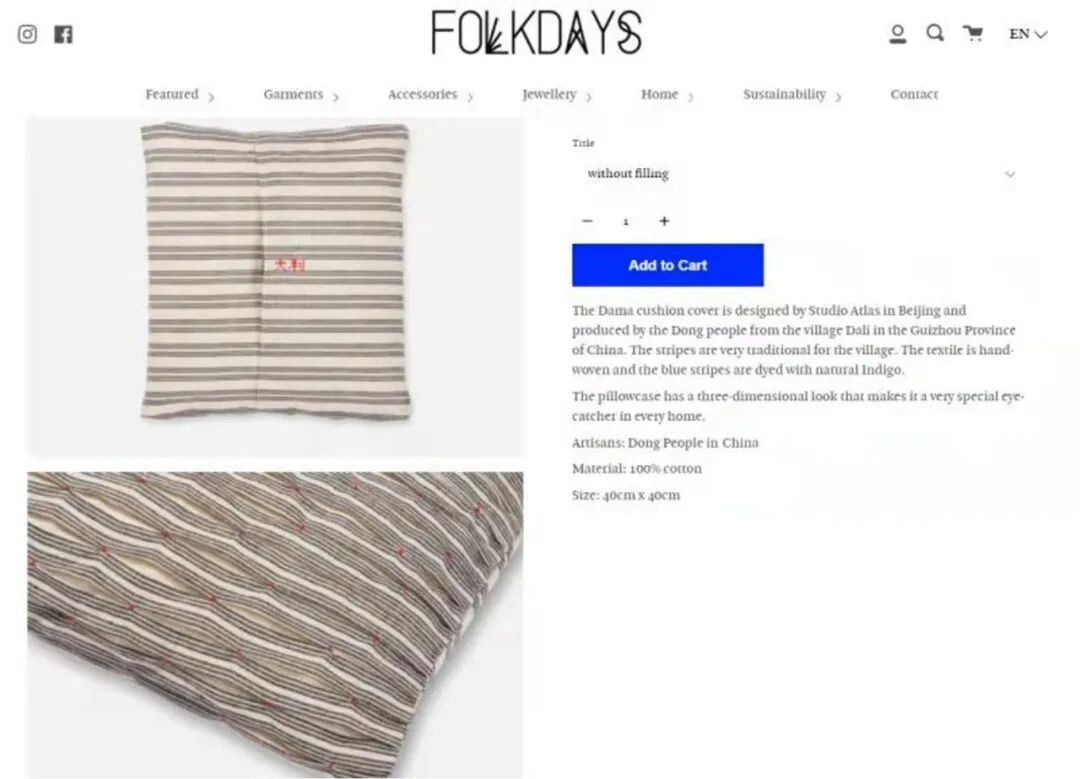


▲ Exhibitions, sales, and related activities of the Dali Women’s Textile Cooperative (slide to view)
Source: Provided by Zhou Zhenzheng
Wang Yuchen:
Can the products currently only be purchased directly from local women? Are there other sales channels such as brands? What roles do these channels play?
Li Guanghan:
Products are mainly purchased directly from the women. We also opened an online WeChat store, but they lack the technical skills to maintain it.
Handicrafts cannot be mass-produced.
China also lacks the mature collaborative models between businesses and craftspeople that exist in countries such as Italy and France, where haute couture brands commission highly labor-intensive handcraft collaborations.
At present, we can only cooperate with ordinary village women who lack business experience. This requires training in ideas, craftsmanship, management, and many other areas.
Li Ang:
A somewhat pragmatic question: have the local embroiderers actually increased their income through this project? Could they eventually avoid migrant labor entirely and support themselves through this project alone? Has the project met their income expectations?
Li Guanghan:
In practice, we often encounter young people who think handicrafts are too technically demanding and difficult to profit from, making them unwilling to participate.
Yet if they seriously complete enough orders, their income can match or even exceed what they would earn working elsewhere.
Some older women also feel that doing such demanding work is less worthwhile than staying home to care for grandchildren.
This is a very contradictory mentality.
Zhou Zhenzheng:
Our products are intended for higher-end stores in cities like Beijing and Shanghai, so quality requirements are very high. Some local women find these standards too demanding and do not want to participate.
Hand weaving is also highly dependent on individual efficiency. Some women can finish orders within one month, while others may need three months.
Because of this, we often cannot evaluate the work according to ordinary commercial standards.
In addition, the Chinese market generally values handicrafts much lower than overseas markets. Although our products possess real value, they still face many disadvantages when competing with luxury brands.
The above discussion was revised on August 22, 2023.
— End —
▼
Participant Biographies
Li Guanghan
Assistant Director, UNESCO Asia-Pacific Heritage Training and Research Institute for World Heritage (Beijing)
Li Ang
Culture Programme Assistant, UNESCO Office in China
Xie Li
Associate Research Fellow, China Association for Conservation Technology of Cultural Heritage
Philipp Demgenski
Researcher, Hundred Talents Program, Institute of Anthropology, Department of Sociology, Zhejiang University
Wang Siyu
Assistant Professor, School of Archaeology and Museology, Peking University
Wu Jie
Associate Research Curator, National Museum of Ethnology of China
Zhang Lisheng
Assistant Professor, Department of Sociology, Peking University
Luo Pan
Associate Research Curator, Research Department, National Museum of Ethnology of China
Duan Niudou
Lecturer, School of Humanities, Central Academy of Fine Arts
Zhou Zhenzheng
Founder, Atlas Studio
Wang Yuchen
Associate Professor, Institute for the History of Science and Cultural Heritage, University of Science and Technology Beijing
Du Lindong
PhD Candidate, School of Architecture, Tsinghua University
Cai Shiyu
PhD Candidate, School of Archaeology and Museology, Peking University
Li Ruikang
PhD Candidate, School of Arts, Peking University
Zheng Zhaoqi
Master’s Student, School of Archaeology and Museology, Peking University
Sun Jing
Associate Professor, China Quanzhou Cultural Heritage Research Institute, Quanzhou Normal University
Sun Lina
Lecturer, School of Architecture and Urban Planning, Beijing University of Civil Engineering and Architecture
Li Jin
Assistant Professor, School of Sociology and Anthropology, Xiamen University
Li Hanchun
Architect, Architectural Design and Research Institute of Tsinghua University; Master’s Graduate, The Bartlett School of Architecture, University College London
Wang Shaohan
Assistant Professor, School of Arts, Peking University
▲
Meeting Notes: Li Ruikang, Zheng Zhaoqi
Meeting Compilation: Du Lindong
Review Editors: Li Guanghan, Wang Siyu
Public Account Editors: Du Lindong, Park Lina
Final Review: Shen Ruiwen, Zhang Jianwei
The copyright for the layout of this article belongs to “Peking University Cultural Heritage Research.”
All speaking content was provided by the speakers themselves, and copyright belongs to the respective speakers.
Sharing is welcome. For republication, please contact “Peking University Cultural Heritage Research.”
Previous Recommendations
Review | Youth Heritage Salon Vol. 1: Re-critique Based on Heritage Criticism (Part 1)
Review | Youth Heritage Salon Vol. 1: Re-critique Based on Heritage Criticism (Part 2)
Review | Youth Heritage Salon Vol. 2: Toward Desecularized Heritage (Part 1)
Review | Youth Heritage Salon Vol. 2: Toward Desecularized Heritage (Part 2)
Review | Youth Heritage Salon Vol. 3: Echoes of Heritage
Review | Youth Heritage Alliance Salon Summary Vol. 4 (Introduction): Protection, Utilization, and Transmission of Linear Heritage Values
Review | Youth Heritage Alliance Salon Summary Vol. 4 (Discussion): Protection, Utilization, and Transmission of Linear Heritage Values
Review | Youth Heritage Alliance Salon Summary Vol. 5: The Difference Between “Use” and “Viewing” — The Special Nature of Architectural Heritage Conservation
Review | Youth Heritage Alliance Salon Summary Vol. 6: Telling China’s Cultural Heritage Story: Official, Local, and Client Perspectives
Review | Youth Heritage Alliance Salon Summary Vol. 7: The “Model Character” of Heritage Cities and the Sustainable Development of World Heritage Ecological Culture