International Heritage News
01
UNESCO May List Venice as an Endangered World Heritage Site

Due to the “irreversible” threats facing Venice — including overtourism, high-rise construction, and sea-level rise caused by climate change — UNESCO is once again considering placing the city on the List of World Heritage in Danger after a two-year interval. In a document released yesterday (WHC/23/45.COM/7B.Add), UNESCO stated that the Italian government lacks a “strategic vision” for addressing threats such as climate change and urged it to strengthen World Heritage protection.
Text and image source: International Heritage Observer

02
UNESCO Asia-Pacific 2023 Living Heritage Lesson Plan Competition Launched

UNESCO’s 2023 Asia-Pacific Living Heritage Lesson Plan Competition has recently been launched. The competition invites schools across the Asia-Pacific region to submit innovative lesson plans related to living heritage or intangible cultural heritage in order to deepen understanding of the rich cultural traditions of diverse communities throughout the region.
The competition includes four award categories:
Living Heritage Promotion Award, Teaching Innovation Award, Sustainable Development Contribution Award, and Jury Special Award. Winning lesson plans will receive certificates and a prize of USD 1,000. In addition, nomination certificates will be awarded to 20 outstanding lesson plans.
All lesson plans will be displayed on UNESCO’s global Living Heritage and Education Exchange Platform.
The submission deadline is September 30.
Text and image source: International Heritage Observer
03
GCI and the V&A Museum to Hold Climate Change Management Strategies Workshop in 2024

Against the backdrop of increasingly severe climate crises faced by global cultural heritage institutions, the Getty Conservation Institute (GCI) and the Victoria and Albert Museum (V&A) will hold a Climate Change Management Strategies Workshop in London from February 5–8, 2024.
Agenda:
1.Introduction to changing environmental and policy contexts
2.Examination of the key role of risk assessment and environmental monitoring as tools supporting decision-making
3.Presentation and discussion of cultural heritage monitoring technologies
4.Sharing case studies of more sustainable museum construction
Participation is limited to 40 people. Priority will be given to museum professionals involved in management decision-making who are able to apply and disseminate the workshop content in practice. Registration closes on September 20.
Text and image source: International Heritage Observer
04
ICCROM Website Releases Survey on Digital Heritage and User Engagement

The International Centre for the Study of the Preservation and Restoration of Cultural Property’s newest initiative, “Sustaining Digital Heritage” (SDH), aims to collect and disseminate strategies and tools for the conservation and creative use of digital heritage. The SDH team has prepared a survey questionnaire to study how cultural institutions identify digital heritage and engage with their user communities.
Text and image source: iccrom.org
05
ICCROM Online Seminar: Japanese Perspectives on 3D Documentation of Cultural Heritage
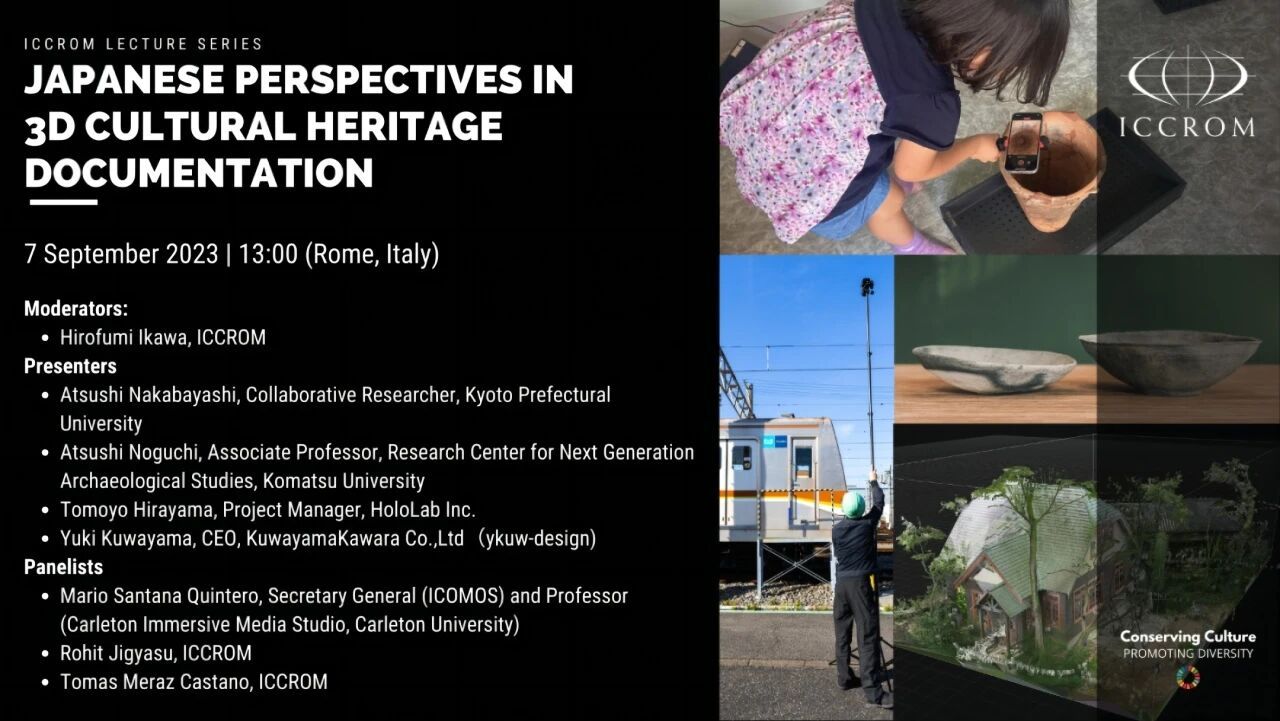
ICCROM will hold an online seminar on September 7 on the theme “Japanese Perspectives on 3D Documentation of Cultural Heritage.” The seminar will showcase the achievements of the cutting-edge cultural heritage technology platform “Data Science Salon,” deepen understanding of new technologies, and promote greater international collaboration.
Text and image source: International Heritage Observer
Domestic Heritage News
01
Sichuan Provincial Cultural Heritage Administration Holds Expert Symposium on Implementing President Xi Jinping’s Instructions on Cultural Heritage Work During His Visit to Sichuan

On July 25 and 26, President Xi Jinping inspected the Cuiyun Corridor of the Ancient Shu Roads, the new Sanxingdui Museum building, and the Sanxingdui Cultural Relics Conservation and Restoration Center, issuing important instructions. On August 7, an expert symposium on implementing the spirit of President Xi’s important instructions during his Sichuan visit was held in Chengdu. Experts and scholars from institutions including the Institute of Archaeology of the Chinese Academy of Social Sciences, the Chinese Academy of Cultural Heritage, Peking University, Beijing Union University, Shanghai University, Sichuan University, Southwest Jiaotong University, Southwest Minzu University, China West Normal University, the Sichuan Provincial Institute of Cultural Relics and Archaeology, the Chengdu Institute of Cultural Relics and Archaeology, and the Sanxingdui Museum attended and exchanged views.
Sun Hua, professor at Peking University, suggested continuously carrying out comparative studies of unearthed Sanxingdui artifacts and conducting reconstructions at the individual, assemblage, and scene levels. He also emphasized that cultural relic restoration should embody the spirit of craftsmanship and sustained dedication. Governments in areas where Shu Road heritage sites are located should formulate laws and regulations for Shu Road protection as soon as possible.
Zhang Jianwei, Associate Dean of the School of Archaeology and Museology at Peking University, stated that universities would continue contributing to basic research, value interpretation studies, and talent cultivation. Peking University would strengthen cooperation with Sichuan in areas including Sanxingdui archaeology, Shu Road studies, Song-Yuan mountain fortress archaeology, and grotto temple archaeology.
Text and image source: Sichuan Provincial Cultural Heritage Administration
02
National Cultural Heritage Administration Deploys Preparatory Work for the Fourth National Cultural Relics Census

The National Cultural Heritage Administration issued the “Notice on Carrying Out Preparatory Work for the Fourth National Cultural Relics Census.” The fourth national census represents the largest-scale cultural heritage protection initiative during the 14th Five-Year Plan period and will conduct field investigations using counties as the basic unit.
The Administration requires provincial-level cultural heritage authorities to fully consider factors such as the quantity and distribution of immovable cultural relics, transportation conditions, and institutional staffing when determining organizational approaches for the census. During the preparatory phase, local authorities must establish preliminary protection mechanisms for surveyed objects listed as clues, and such objects may not be relocated or demolished before completing the cultural relic identification procedures.
Using counties as the basic unit, local governments are also required to establish inventories of officially recognized immovable cultural relics and compare them one by one with cultural heritage protection unit lists at all levels, clearly identifying the protection level of each site.
Text and image source: National Cultural Heritage Administration
03
Thirteen Provinces and Cities Collaborate Across Regions to Paint the “Prosperous China: Why China?” Contemporary Cultural Landscape

On July 9, the online themed publicity campaign “Prosperous China: Why China?” jointly guided by the Cyberspace Administration of China, the National Cultural Heritage Administration, People’s Daily, and the Shaanxi Provincial Cyberspace Affairs Commission, was launched in Xi’an, Shaanxi. The campaign seeks to trace the origins of history and revisit the roots of civilization.
In recent days, under the unified deployment of the Cyberspace Administration of China and the National Cultural Heritage Administration, cyberspace and cultural heritage departments in Beijing, Shanxi, Shanghai, Jiangsu, Zhejiang, Fujian, Shandong, Henan, Hubei, Hunan, Sichuan, Shaanxi, and Gansu have cooperated across sectors to launch relay-style online and offline promotional activities. Using cultural relics, culture, and civilization as the soul, and empowering them through technology, platforms, and applications, the campaign aims to continue historical traditions and compose a new contemporary chapter.
Text and image source: National Cultural Heritage Administration
04
2023 Joint Workshop on Cultural Heritage Conservation — Peking University Summer Course Concludes in Chongqing

On August 2, the 2023 Joint Workshop on Cultural Heritage Conservation Peking University Summer Course, jointly organized by the School of Archaeology and Museology at Peking University, the UNESCO Category II Centre for World Heritage Training and Research for the Asia-Pacific Region in Beijing (WHITRAP-Beijing), and the Public Archaeology and Art Center of Peking University, successfully concluded in Chongqing.
The closing presentation session was hosted by Zhang Jianwei, Associate Dean of the School of Archaeology and Museology at Peking University and Executive Deputy Director of WHITRAP-Beijing. The closing ceremony consisted of three parts: presentations of findings by each research group, a special research report on the Jiukouguo area, and expert comments and summaries.
Over the course of ten days, participants explored every corner of Diaoyu Fortress. Under the guidance of workshop instructors, they produced illustrated research reports exceeding ten thousand Chinese characters. Walking along Chongqing’s rain-soaked stone roads during the rainy season, participants touched every inch of Diaoyu Fortress’s history. Through intensive field surveys, interviews, discussions, and reflection, they documented the fortress’s past and present, opening new possibilities for the conservation, display, and utilization of Diaoyu Fortress from four different perspectives: space, community, archaeology, and interpretation.
Text and image source: WHITRAP-BEIJING
05
China’s National Commission for UNESCO Recommends Two Cities for the Creative Cities Network

China’s National Commission for UNESCO has recommended Chongqing and Chaozhou for inclusion in the UNESCO Creative Cities Network. The application categories are design and gastronomy.
China currently has 16 Creative Cities, the largest number in the world. Their categories and years of designation are as follows:
Design: Beijing (2012), Shenzhen (2008), Shanghai (2010), Wuhan (2017)
Gastronomy: Chengdu (2010), Shunde (2014), Macau (2017), Yangzhou (2019), Huai’an (2021)
Crafts and Folk Art: Hangzhou (2012), Jingdezhen (2014), Suzhou (2014), Weifang (2021)
Media Arts: Changsha (2017)
Film: Qingdao (2017)
Literature: Nanjing (2019)
Music: None
The application results are expected to be announced on October 31, United Nations World Cities Day.
Text and image source: International Heritage Observer
Compiled by: Lü Jiaxin
Edited by: Lü Jiaxin, Park Lina
Reviewed by: Li Guanghan, Wang Siyu
Final Review by: Shen Ruiwen, Zhang Jianwei