From July 15 to July 17, 2023, the online training phase of the 2023 Joint Workshop on Cultural Heritage Conservation – Peking University Summer Course was officially launched. The workshop was jointly organized by the School of Archaeology and Museology at Peking University, the UNESCO World Heritage Institute of Training and Research for the Asia and Pacific Region (Beijing) (WHITRAP-Beijing), and the Peking University Center for Public Archaeology and Art. During the three-day online teaching program, workshop instructors and invited experts approached the topic from perspectives including interdisciplinary heritage conservation thinking, ecology, geology and geomorphology, heritage tourism, heritage value cognition, and the history of Sichuan-Chongqing mountain fortresses. Drawing on the theories and methodologies of their respective disciplines, they analyzed research approaches and current studies on Diaoyu City from different academic backgrounds.

Poster for the 2023 Joint Workshop on Cultural Heritage Conservation
Before the lectures began, Wang Siyu, Assistant Professor at the School of Archaeology and Museology at Peking University and Director of the Peking University Center for Public Archaeology and Art, hosted the online opening ceremony. Dr. Li Guanghan, Assistant Director of WHITRAP-Beijing, introduced the workshop’s philosophy and the general framework of this year’s program, while the lead instructors and several invited experts briefly met with the students.
After the opening ceremony, Zhang Jianwei, Vice Dean and Tenured Associate Professor at the School of Archaeology and Museology at Peking University and Executive Deputy Director of WHITRAP-Beijing, delivered a lecture titled “The Practice of Cultural Heritage Workshops.” Based on a systematic review of the experiences and achievements of previous workshops, Zhang emphasized the workshop’s educational goal of addressing local needs and its interdisciplinary methodology of “seeking intersections” and “seeking unions” among disciplines. He clarified key stages of the project, including online learning, field investigation, and issue integration, and discussed through practical examples the long-term benefits the workshop has brought to both local communities and participants.
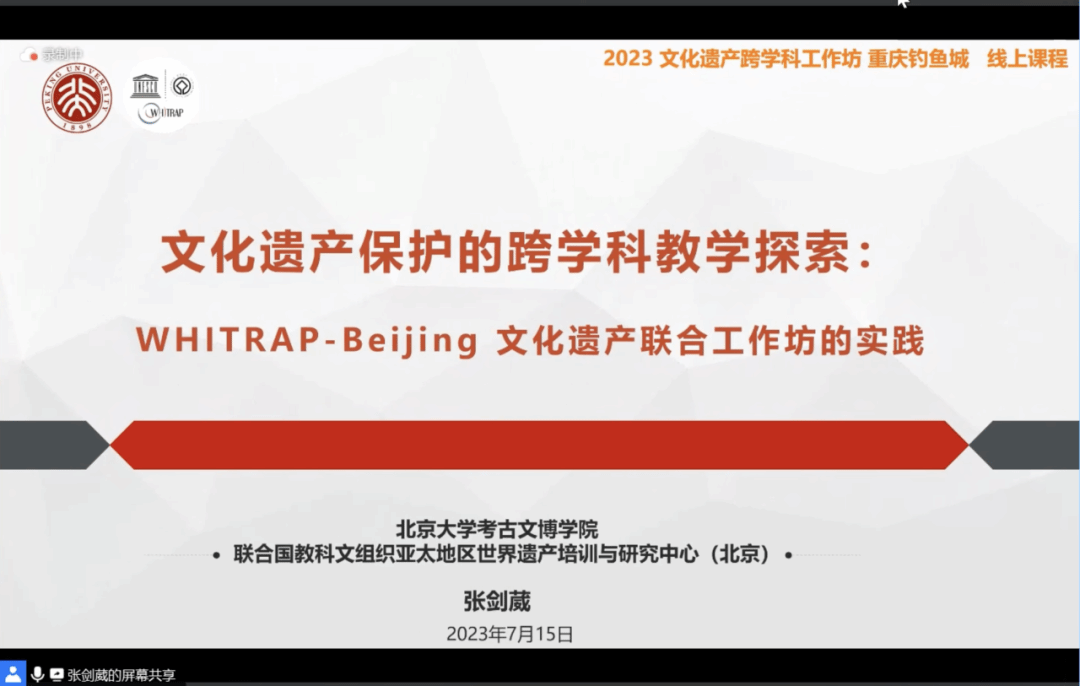
Zhang Jianwei lecturing
Li Dihua, Vice Dean and Associate Professor at the College of Architecture and Landscape at Peking University and Deputy Director of WHITRAP-Beijing, gave a lecture titled “Ecological Thinking and Basic Concepts in Heritage Conservation.” He discussed how ecology and ecological concepts manifest in daily human life, introduced ecological concepts applicable to heritage conservation, and explored how ecological thinking can inform both natural and cultural heritage protection. Drawing on classic examples such as heritage conservation projects in Lille, France, Li proposed that ecology should become a mode of thinking for protecting natural and cultural heritage.

Li Dihua lecturing
Associate Professor Wu Honglin from the College of Urban and Environmental Sciences at Peking University taught a course titled “A Glimpse into the Geology, Geomorphology, and Regional Historical Geography of Diaoyu City.” Starting with foundational geological knowledge, he explained stratigraphy and lithology, structural geology, and paleontological stratigraphy. He then introduced the elements of geological maps and methods for retrieving them, using river landforms as an example to explain geomorphological formation processes. Finally, he outlined the geological and geomorphological background of the Diaoyu City region, noting that the terrain is characterized by plateau-like landforms and that its unique geological context is closely tied to its defensive system. He also encouraged students to think further from perspectives including climate and environmental change, archaeological materials from Chongqing, historical documents, and the Southern Song mountain fortress defense system in Sichuan.

Wu Honglin lecturing
Associate Professor Gao Jun from the School of Tourism Management at Sun Yat-sen University delivered a lecture titled “Heritage Tourism Research and Topic Selection.” By reviewing the development of tourism studies in China, Gao pointed out that current tourism research is characterized by strong interdisciplinary interaction. Regarding research topic selection, he proposed four forms of innovation: context and research object, problems, perspectives, and methods/tools. Drawing on numerous examples, he shared his experience in heritage tourism research. Gao advised students to read extensively, “stand on the shoulders of giants,” conduct research with local advantages, respond to real-world and national needs, and pursue topics with long-term potential and emerging trends.
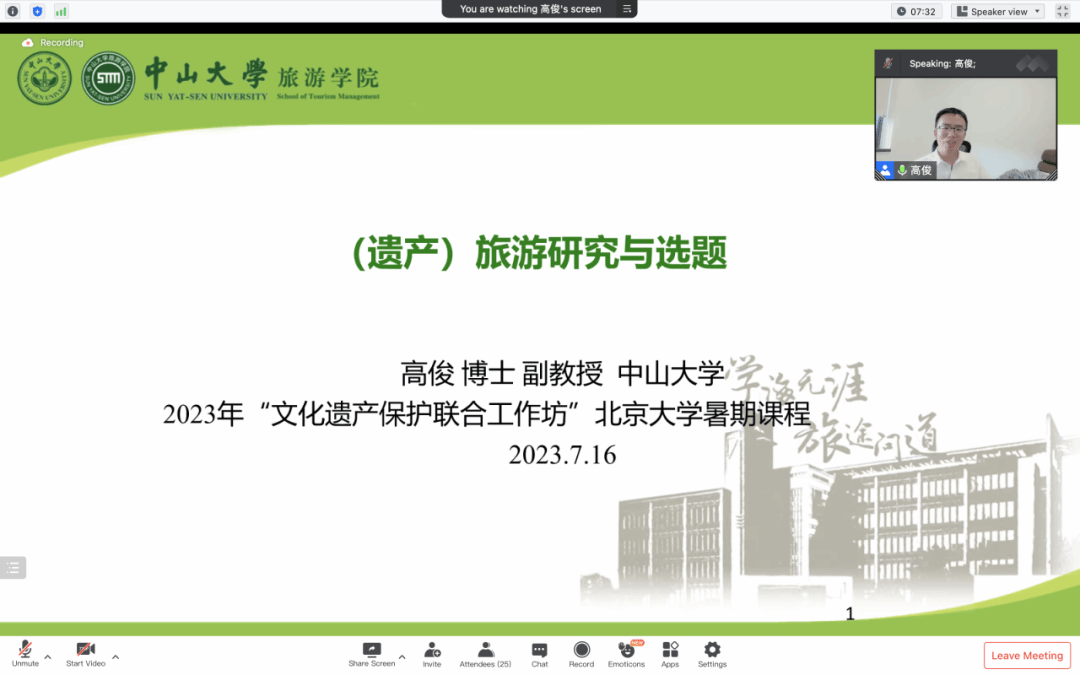
Gao Jun lecturing
Professor Du Xiaofan from the Department of Cultural Heritage and Museology at Fudan University delivered a lecture titled “Methods and Practices of Cultural Heritage Value Recognition: The Diaoyu City Site as a Case Study.” Beginning with the question “Why should we protect cultural heritage?”, Du stated that the core goals of heritage conservation are to strengthen a shared sense of Chinese national identity, build cultural confidence, enhance cultural soft power, and contribute to a global community with a shared future. Du encouraged students to pay attention to changes in heritage across time and space, the ways different groups culturally shape nature, and the holistic structures of multiple causes. Specifically regarding the value of the Diaoyu City site, he suggested students consider the natural environment and human construction together from the perspective of cultural landscapes, so as to understand the unique Eastern defensive philosophy through the site’s urban uniqueness, mountain construction characteristics, high degree of environmental adaptation, and historical influence.
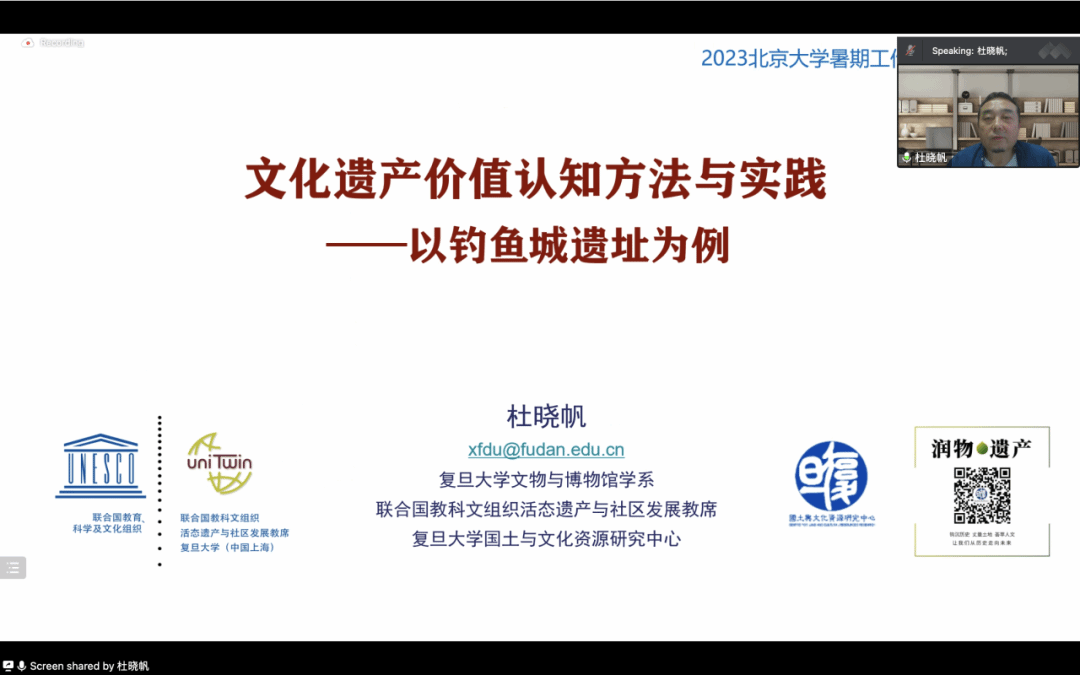
Du Xiaofan lecturing
Professor Sun Hua from the School of Archaeology and Museology at Peking University and Director of the Peking University Center for Cultural Heritage Research delivered a lecture titled “An Overview of Southern Song Mountain Fortresses in Sichuan and Chongqing,” drawing on his many years of archaeological work in southwest China. From the perspective of urban functions, Sun first outlined the military functions of mountain fortresses in contrast to political and economic cities. Combining specific historical events from the Song-Mongol wars, he reviewed the phased establishment of the mountain fortress system and explained the hierarchical administrative structures of military commissioners, regional offices, prefectures, counties, and other institutions. According to geographical conditions, he categorized fortresses into mountaintop, hillside, peninsula, island, and composite types. Finally, he comprehensively summarized the historical value of Southern Song mountain fortresses in Sichuan and Chongqing from the perspectives of urban history, Song-Yuan war history, architectural history, and military history, while also pointing toward future World Heritage nomination efforts.

Sun Hua lecturing
On July 24, the workshop’s offline field investigation phase would officially begin. Before entering the field, students, guided by teaching assistants, reviewed literature related to history, archaeology, geographical landscapes, tourism presentation, value studies, and conservation planning. They summarized existing research and presented their preliminary findings before the opening of the field phase. After the offline launch, students would conduct fieldwork at the Diaoyu City site in Hechuan District, Chongqing under the guidance of instructors. Divided into archaeology, geology and geomorphology, tourism management, and community groups, they would carry out foundational research, current condition assessments, and preliminary design proposals for the conservation and presentation of Diaoyu City based on the core values of Sichuan-Chongqing mountain fortresses.
Workshop Lead Instructors:
Zhang Jianwei – Tenured Associate Professor and Vice Dean, School of Archaeology and Museology, Peking University
Wang Siyu – Assistant Professor, School of Archaeology and Museology, Peking University
Li Guanghan – Assistant Director, UNESCO World Heritage Institute of Training and Research for the Asia and Pacific Region (Beijing)
Invited Experts:
Sun Hua – Professor, School of Archaeology and Museology, Peking University; Director, Peking University Center for Cultural Heritage Research
Du Xiaofan – Professor, Department of Cultural Heritage and Museology, Fudan University; Director, Fudan University Center for Land and Cultural Resources Research
Wu Honglin – Associate Professor, College of Urban and Environmental Sciences, Peking University
Li Dihua – Associate Professor and Vice Dean, College of Architecture and Landscape, Peking University
Yuan Dongshan – Deputy Director, Chongqing Institute of Cultural Relics and Archaeology; President, Chongqing Cultural Relics and Archaeological Sites Protection Association
Gao Jun – Associate Professor, School of Tourism Management, Sun Yat-sen University
Sun Jing – Associate Professor, Quanzhou Institute of Cultural Heritage, Quanzhou Normal University
Wang Yifei – Postdoctoral Researcher, Fudan University
Organizing Institutions:
Organizers: School of Archaeology and Museology, Peking University; UNESCO World Heritage Institute of Training and Research for the Asia and Pacific Region (Beijing)
Co-organizer: Peking University Center for Public Archaeology and Art
Supporting Institutions: Chongqing Cultural Relics and Archaeological Sites Protection Association; Diaoyu City Scenic Area Affairs Center
Written by: Zheng Zhaoqi, Li Chaoying
Edited by: Piao Lina, Li Chaoying
Reviewed by: Li Guanghan, Wang Siyu
Final Review: Shen Ruiwen, Zhang Jianwei