On 9 June 2023, within the framework of “The Next 50” global celebration of the UNESCO 1972 Convention concerning the Protection of the World Cultural and Natural Heritage and in collaboration with Hangzhou Municipal Government, UNESCO Multisectoral Regional Office for East Asia successfully organized the Symposium on Water Heritage for Cities’ Sustainable Development. Bringing together experts, professionals and managers from diverse expertise and sectors, the symposium explored the role of water as heritage in cities – especially historic cities and settlements – and identified opportunities to further utilize this natural and cultural heritage to address ongoing and emerging challenges. The symposium’s speakers and panelists also discussed innovative approaches to integrate water heritage into larger climate and environmental efforts in the year to come to strengthen the cities’ environmental, social and economic resilience.
Dr. Li Kuanghan, Assistant Director of World Heritage Institute of Training and Research for the Asia and the Pacific Region under the auspices of UNESCO (Beijing) from School of Archaeology and Museology of Peking University, moderated the first session of the workshop(Water and Cultural Landscape) and presented a keynote speech on the subject.
Opening Ceremony
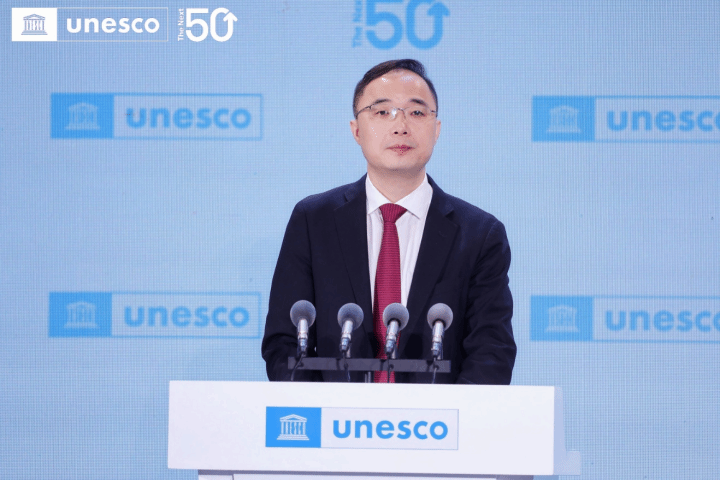
Vice Mayor of Hangzhou Municipal Government, Sun Xudong, Director of UNESCO Multisectoral Regional Office for East Asia, Shahbaz Khan, and Head of the Austrian Cultural Forum Beijing, Christian Mandl delivered opening remarks.
Mr. Sun Xudong shared “Hangzhou experience” in the management of three World Heritage sites – West Lake Cultural Landscape of Hangzhou (2011), The Grand Canal (2014) and Archaeological Ruins of Liangzhu City (2019) – with the two of them representing outstanding water heritage of China. Hangzhou is committed to work together with different social groups to protect cultural diversity and biodiversity for sustainable development.

Prof. Shahbaz Khan highly recognized Hangzhou’s great achievements in water heritage preservation, and he believed that the gathering of water and heritage experts through UNESCO’s collaboration with Hangzhou can further strengthen Hangzhou’s capacity in building a “World Water Capital”.

Mr. Christian Mandl shared the role of water in Austrian World Heritage properties, and he believed that the symposium can build an international platform for encounters and offer a good opportunity to exchange experiences and commonalities and to serve as a model for other cities.
The symposium shed light on the following four themes:
·Water as cultural landscapes
·Managing water in historic cities
·Water innovation and creativity
·Integrating water and heritage for cities’ sustainability
Session 1: Water as cultural landscapes

The moderator of the panel, Dr. Kuanghan Li from UNESCO Category 2 Center WHITRAP-Beijing and Peking University School of Archaeology and Museology, opened with a keynote speech to introduce the role of water in defining landscapes and how to embed water heritage into sustainable landscape conservation and management. She suggested that water heritage conservation should be embedded into sustainable landscapes, combining its biological values with spiritual ones and focusing on connectivity in the catchment area. She further led to the two main questions to be discussed in this session: What are the successful examples in addressing the issues related to urgent water-related issues in landscape management and heritage protection in the Asia-Pacific region? How do we bridge the gap between heritage and water management professionals to develop a collaborative framework?

Prof. Chaohui Liu from Zhejiang University presented his research on the boat people of the China’s Grand Canal and how we can learn from their experiences and wisdom on water-related knowledge.
Together with Ms. Anna Yau, independent conservationist from Hong Kong, and Prof. Joon Sik Kim of Xi’an Jiaotong-Liverpool University, the panelists discussed water-related issues in landscape management and heritage protection specific to the Asia and Pacific region, and examples of viable solutions and case studies. The panel then concluded with the discussion on how to bridge the gap across water resource management and conservation related sectors, and proposed landscape-based, placed-based and human-centric approaches. The discussion also emphasized the importance of partnership building and multilateral dialogues.
Session 2: Managing water in historic cities

The session began with two keynote speeches. Dr. Sharif Shams Imon of Macao Institute for Tourism Studies – the panel’s moderator – kicked off the session with a presentation that explored the historical significance of water in shaping human civilizations, as well as its role in contemporary cities. He emphasized the need to reconnect water with the lives of residents in historic cities, as the disassociation of water from daily life has had a negative impact. Ms. Zhang Shuheng from Zhejiang Institute of Cultural Relics and Archeology showcased the importance of understanding traditional water-based transport systems and their associated human settlements in making better conservation decisions, using Xixing Town as an example.
During the discussion, also joined by Prof. Dong Wei of Southeast University and Ms. Huang Xiaodan from the World Bank Group, different but complementary views were shared on how to manage water for the future of historic cities. It was concluded that water and cities are part of a dynamic and large system, and an integrated and multi-dimensional approach at a regional level, based on traditional knowledge but utilizing current knowledge and technology, is necessary. Knowledge sharing and awareness raising between professionals and communities were emphasized as crucial for effective implementation.
Session 3: Water innovation and creativity

The focus of the discussion, according to Prof. Philippe Gourbesville from the Polytech Nice Sophia, was “what exactly is innovation?”. To respond the question, Prof. Gourbesville shared examples of good practices of France, South Korea and Indonesia. Ms. Wu Zhiying (Former Director of Hangzhou West Lake World Cultural Heritage Monitoring and Management Center) shared the case of “Water Revival” by Hangzhou Changqiao Stream Eco-Restoration Park. Dr. Hu Lian (Associate Professor of Tianjin University) introduced the innovative project of the Tianjin section of the Grand Canal in Yangliuqing Town. Lastly, Dr. Mu Jianxin (Consultant of UNESCO) analyzed eco-hydrological solutions for wetland restoration in Fangshan district, Beijing. During the discussion session moderated by Prof. Gourbesville, the panelists gave a more in-depth analysis of how good practices in their cases can be applied to a wider range of fields. Panelists agreed that innovation requires a holistic perspective that addresses different aspects of society in order to find a sustainable management model.
Session 4: Integrating water and heritage for cities’ sustainability

The session was initiated by Dr. Faith Chan (from University of Nottingham Ningbo China)’s keynote speech with an in-depth analysis of ancient water infrastructure in Hangzhou and Ningbo. These examples opened up the discussion about the “transformation” on the city’s sustainable development and how to address current and future challenges such as urbanisation and climate change by leveraging these treasurable ancient Chinese water infrastructures. Prof. Li Na from China Institute of Water Resources and Hydropower Research, Prof. Luo Yufeng from Wuhan University, Prof. Dong Danshen from Zhejiang Univeristy and Mr. Sun Haibo from Liangzhu World Heritage Management Centre participated in the discussion. The panelists believed that “we should keep these infrastructures alive”. Since most of infrastructure are still in active use nowadays, it’s important to preserve these valuable heritages through legislation and urban planning. At the same time, stakeholders including civil societies and communities should co-produce and work together to embrace these infrastructures and extend its value to the next generations.
The symposium suggested many possible topics for future interventions and opened up many opportunities for collaboration, among experts from different fields, among stakeholders from different sectors. UNESCO and Hangzhou will explore future occasions to introduce Hangzhou experiences to wider audiences, and work together to apply the international experiences learned from the symposium to enhance the management and values of water heritage in this beautiful city.