International Heritage News
01
WHW 11th International NGO Forum on World Heritage Calls for Papers
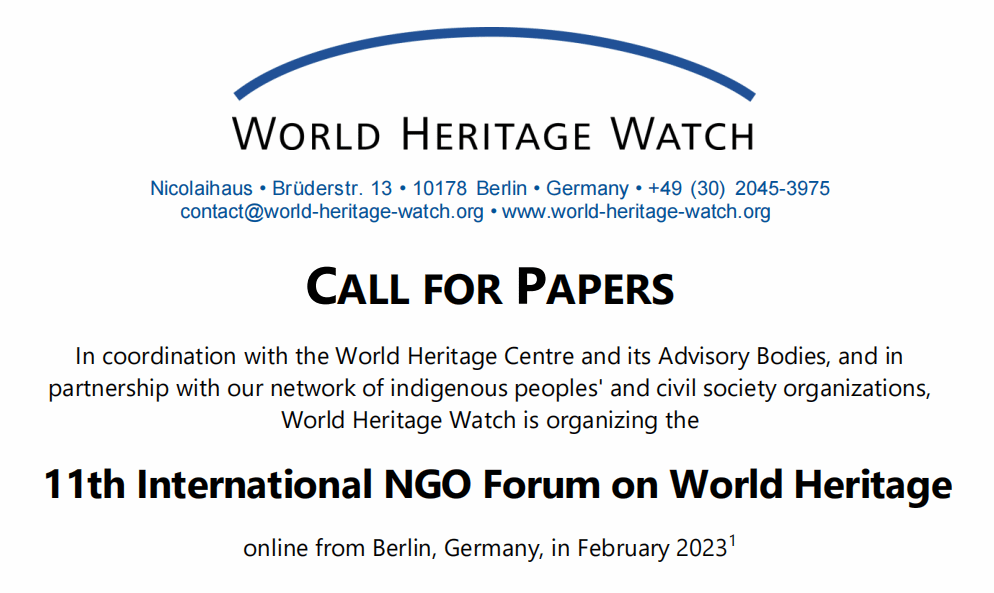
World Heritage Watch (WHW) will hold its 11th International NGO Forum on World Heritage online in February. The forum is calling for papers on issues related to World Heritage protection that should be brought to the attention of the UNESCO World Heritage Committee.
Submissions should focus on emerging issues that have not yet been addressed by UNESCO or States Parties, particularly urgent matters on the Committee’s agenda. Papers should be grounded in previous World Heritage Committee decisions and reflect the perspectives of local communities and civil society organizations.
In addition to inscribed World Heritage properties, the forum will also discuss sites on the Tentative List and sites that should be included on it. The forum aims to support more comprehensive assessments by the World Heritage Committee and its advisory bodies, enabling better-informed decisions at the World Heritage Convention.
NGOs, Indigenous peoples, heritage professionals, and civil society actors from all backgrounds are invited to submit contributions. Submission email: contact@world-heritage-watch.org. Deadline: February 10, 2023. Selected papers may be included in WHW’s 2023 annual report to be published in June.
02
US Congress Passes Bill that may Facilitate US Return to UNESCO

The World Heritage USA reported that, after more than a decade of unpaid dues and withdrawal in 2018, a bill passed by the US Congress and signed by the President at the end of last year may enable the United States to rejoin UNESCO.
Congress also significantly increased funding for the State Department’s support of UNESCO and other international organizations. The US government views support for multilateral institutions increasingly as an expression of “soft power.”
In the coming months, World Heritage USA plans to work with professionals in cultural and natural heritage fields, government agencies, and Congress to ensure the US resumes payment of dues and regains a leadership role in World Heritage affairs.
03
ICCROM expresses concern over damage to Brasília World Heritage site

On January 10, the ICCROM expressed concern regarding recent damage to cultural heritage in Brasília World Heritage Site, including its buildings and associated objects.
Founded in 1956, Brasília represents a major milestone in urban planning history as an outstanding example of a modernist planned national capital. In 1987, it was inscribed on the World Heritage List under criteria (i) and (iv).
ICCROM called for respect for all cultural heritage in Brasília and stated that, if requested by the Brazilian government, it stands ready to provide advisory and technical support to heritage professionals in addressing conservation issues related to restoration.
04
Fourth OWHC Asia-Pacific Conference “Silk Road and World Heritage Cities” Planned in Gyeongju

The fourth regional conference of the Organization of World Heritage Cities (OWHC) Asia-Pacific Secretariat, hosted by Gyeongju City in South Korea, is scheduled for September under the theme “Silk Road and World Heritage Cities.”
Marking the 30th anniversary of diplomatic relations between South Korea and Uzbekistan, a delegation from the Secretariat visited Samarkand and Bukhara last December. Samarkand was also invited to participate in the conference on the 10th anniversary of its sister-city relationship with Gyeongju.
During the visit, memoranda of understanding were signed with institutions such as the Samarkand Institute of Archaeology and Bukhara State University to promote cooperation in heritage and culture. The delegation noted that Gyeongju’s Silk Road initiative aims to expand its international engagement, and that this visit marks the beginning of deeper cooperation with Central Asian Silk Road countries.
05
UNESCO–UIA World Capital of Architecture 2023 Pre-Launch Ceremony Held

The pre-launch ceremony of the UNESCO–UIA World Capital of Architecture 2023 was held in Copenhagen. UNESCO Director-General Audrey Azoulay, UIA President José Luis Cortés, and Chair of the World Capital of Architecture Committee Dominique Perrault attended.
Azoulay stated that Copenhagen has in recent decades carried out outstanding urban and architectural experimentation, particularly in relation to nature. Cortés noted the long-standing cooperation between International Union of Architects (UIA) and UNESCO, and announced that the association will celebrate its 75th anniversary in Copenhagen in July.
The 2023 program, themed “Sustainable Futures: Leave No One Behind,” will include more than 200 events, bringing together architects worldwide to explore strategies for addressing climate change and global urban challenges.
Domestic Heritage News
01
National Park Spatial Layout Plan Identifies 49 Candidate National Parks

Recently, with approval from the State Council, four Chinese government agencies jointly issued the “National Park Spatial Layout Plan,” marking a major milestone in China’s national park development and providing strategic guidance for building the world’s largest national park system.
The plan incorporates the most important ecosystems, most unique landscapes, most significant natural heritage, and richest biodiversity areas into the national park system. It identifies 49 candidate national parks (including 5 already established parks), covering terrestrial, land-sea integrated, and marine areas, with a total area of about 1.1 million square kilometers.
Thirteen candidate areas are located on the Qinghai–Tibet Plateau, forming a national park cluster; nine are in the Yellow River Basin, and eleven in the Yangtze River Basin. Once fully completed, China’s national park system will be the largest in the world.
02
National Cultural Heritage Administration: Ensure Successful Inscription of Jingmai Mountain Tea Forest Cultural Landscape

At the national directors’ conference of cultural heritage bureaus on January 5, the head of the National Cultural Heritage Administration of China emphasized ensuring the successful inscription of the “Pu’er Jingmai Mountain Ancient Tea Forest Cultural Landscape,” completing on-site evaluation for the Beijing Central Axis at a high standard, and actively advancing transnational nominations such as the Maritime Silk Road.
In 2023, China will continue major archaeological programs such as the Origin of Chinese Civilization Project and “Archaeology of China,” strengthening research on Xia and Shang civilizations. Key excavations include Erlitou, Yin Ruins, Nanhai No. 1 shipwreck, and Yangtze River Estuary No. 2.
The administration will also advance museum reform, promote world-class museums with Chinese characteristics, improve collection management systems, and strengthen conservation of fragile and endangered artifacts.
03
Fourth Batch of National Archaeological Park List and Projects Announced

The National Cultural Heritage Administration of China announced the fourth batch of national archaeological park designations and approved projects. Nineteen sites, including Nihewan, were designated as national archaeological parks, while 32 sites, including Liulihe, were approved as proposed projects.
So far, a total of 55 national archaeological parks have been officially designated across four batches, with 32 sites in the proposed project list.
04
Largest Western Zhou site discovered within Yin Ruins area

At a briefing by the Chinese Academy of Social Sciences Institute of Archaeology, researchers reported a major discovery within the Yin Ruins area. Survey work conducted since 2021 identified two encircling ditches around the royal cemetery area, interpreted as defensive moats.
In the southeast of the royal cemetery zone, archaeologists also discovered a Western Zhou site exceeding 40,000 square meters—the largest Western Zhou site found within the Yin Ruins area to date.
Researchers concluded that the ditch system predates the early Western Zhou period and shows no stratigraphic overlap with Shang burials or ritual pits, except for later disturbances.
05
WHITRAP-Beijing 2022 annual report


In 2022, the COVID-19 pandemic continued to affect global society and inevitably impacted the work of the UNESCO World Heritage Institute of Training and Research for the Asia and the Pacific Region (WHITRAP). The Beijing Centre actively adapted by shifting many international conferences, training programs, and academic workshops online, while also conducting in-person training and field research when conditions allowed.
At the start of 2023, WHITRAP-Beijing held an end-of-year director meeting and intern summary session to review its work in training, education, research, collaboration, and outreach, and to plan future activities for 2023.