The year 2025 marks the 40th anniversary of China’s accession to the World Heritage Convention. As a Category 2 center under UNESCO, the World Heritage Training and Research Center for the Asia‑Pacific Region (WHITR-AP) Beijing Branch, closely focusing on the World Heritage Convention and UNESCO’s mid‑term strategy, and relying on the research environment and interdisciplinary advantages of Peking University, has actively carried out international training and capacity‑building activities, advanced basic research on world heritage protection and management, and promoted exchanges and cooperation in the heritage field in the Asia‑Pacific region, injecting sustained momentum into heritage protection and mutual learning among civilizations in the region.
Let us now review the main work of the WHITR-AP Beijing Branch in 2025.
01
Organizing International Training and Promoting Capacity Building

Group photo at the workshop opening ceremony
1. Organized the Asia‑Pacific Regional Thematic Workshop Series on World Heritage
From August 10 to 17, the Asia‑Pacific Regional Thematic Workshop Series on World Heritage was successfully held in Quanzhou, Fujian Province. The workshop focused on the important research, protection, and presentation significance of serial heritage in the Asia‑Pacific region, especially transnational and transboundary heritage. It attracted 17 participants from 11 countries and regions and invited 9 experts to provide on‑site instruction.
2. Hosted World Heritage Themed Lectures
On May 18, International Museum Day, co‑hosted with the College of Urban and Environmental Sciences at Peking University the lecture “World Heritage in Russia: The National Image Reflected Through the Prism of Cultural Heritage.”
On December 9, co‑hosted with the College of Architecture and Landscape Architecture at Peking University the lecture “Linking Urban Ecology and Heritage Revitalization: The Cases of Arequipa (Peru), Salvador (Brazil) and Beijing.”
3. Supported World Heritage Themed Exhibitions
From November 20 to December 7, supported the exhibition “China’s Yellow (Bohai) Sea Migratory Bird Habitats Enters Peking University,” jointly organized by the Yancheng Wetland and World Natural Heritage Protection Management Center and the College of Urban and Environmental Sciences at Peking University.
4. Cultivated International Youth Heritage Professionals
In 2025, the Center trained 9 interns from China, France, and Ghana, with majors including archaeology and museology, international relations, and landscape architecture. The Center encouraged interns to leverage their disciplinary strengths and develop their heritage expertise through practice.
02
Conducting Basic Research on World Heritage and Supporting the Nomination, Protection, and Management of World Heritage Sites

Center project results released at the Dunhuang Forum
1. Released Project Outcome: Gansu Province Cultural and Creative Industries Policy Recommendations Guide
On September 22, the Center’s project outcome, Harnessing Culture and Creativity for Sustainable Development: Gansu Province Cultural and Creative Industries Policy Recommendations Guide, was released at the “Dunhuang Forum” of the 8th Silk Road (Dunhuang) International Cultural Expo. Based on the “Urban, Culture, Creativity” (CCC) framework developed by UNESCO and the World Bank, the core content was researched and compiled by the Beijing Branch. The bilingual electronic version of the report has been launched in the Digital Library on the UNESCO official website.
2. Supported Work Related to World Heritage List and Tentative List Nominations
The teams of Center Deputy Directors Jiang Dayong and Li Jianghai were deeply involved in the World Natural Heritage nomination of the “Guizhou Triassic Fossil Assemblage,” systematically advancing the refinement of the nomination dossier, supplementary field surveys, and international expert seminars. They also delivered keynote reports at the Geological Heritage Session of the Eco Forum Global Guiyang, articulating the core value of the heritage.
Center Deputy Director Li Jianghai provided technical consultation for the World Natural Heritage nomination of the “Hesheng Mammalian Fossil Assemblage in Gansu.”
Center Deputy Director Li Jianghai participated in the potential assessment for the inclusion of “Tiantai Mountain in Zhejiang” on the World Heritage Tentative List.
The “Phase II Research on the Feasibility of the Joint Nomination of Baiheliang Inscription in China and the Nilometer in Egypt as a World Cultural Heritage Site” project successfully passed the final review.
3. Conducted Thematic Research on World Heritage Sites
In August, the Center initiated research on segmented interpretation at the Yungang Grottoes, conducting visitor surveys at the World Heritage site of Yungang Grottoes to explore visitor‑oriented inclusive interpretation pathways.
03
Expanding International and Regional Partner Networks and Deepening Exchanges and Mutual Learning
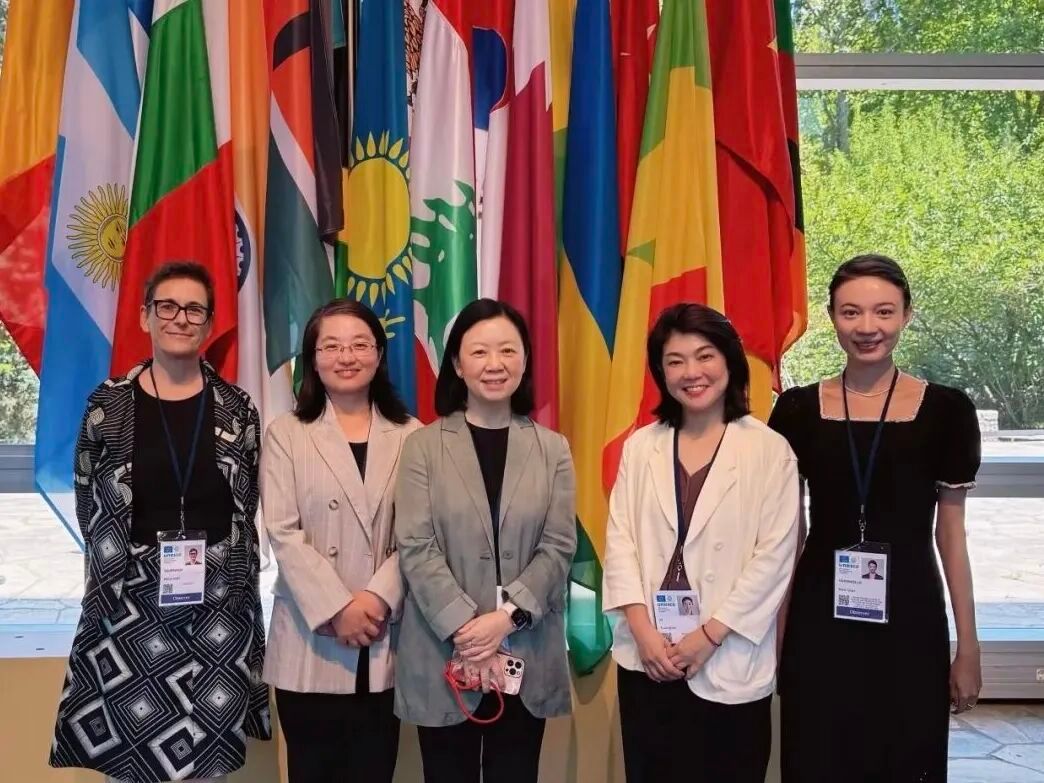
WHITR-AP delegation attending the 47th Session of the World Heritage Committee
1. Participated in the 47th Session of the World Heritage Committee and Hosted a Side Event on Heritage Education
From July 6 to 16, Center Executive Director Li Guanghan and Deputy Director Song Feng attended the 47th Session of the World Heritage Committee in Paris on behalf of the Center.
During the session, they co‑organized with the World Federation of UNESCO Clubs, Centres and Associations (WFUCA) a side event on the theme “World Heritage Education for the Future – Global Innovation Cooperation Network and Capacity Building.” Center Executive Director Li Guanghan was also invited to attend and deliver a keynote speech at the side event “Heritage Interpretation: Regional Practices Connecting Past and Present” organized by the Category 2 center WHIPIC.
2. Participated in the UNESCO‑China‑Africa World Heritage Capacity Building Workshop
From October 19 to 20, Executive Director Li Guanghan and Deputy Director Song Feng were invited to attend the UNESCO‑China‑Africa World Heritage Capacity Building Workshop, engaging in in‑depth discussions on topics of China‑Africa world heritage nomination, protection, and educational cooperation, sharing Chinese experiences, and promoting China‑Africa heritage capacity building and university cooperation.
3. Participated in International and Regional Heritage Exchange Activities
March 29: Supported the 4th Creative 2030 International Forum (Beijing)
May 26: Supported the Asia‑Pacific World Heritage Young Professionals International Exchange Activity (Suzhou)
October 17: Co‑organized the inaugural General Assembly of the RCEP World Heritage Cities Alliance (RCEP-WHCA) (Huangshan, Anhui)
November 5: Supported the 2025 Annual Meeting of the Heritage Asia Pacific (HeritAP) and the “Synergies Between the Intangible and Tangible Heritage Conventions” Working Meeting (Liangzhu, Hangzhou)
4. Received Visits from Heritage Sites and International Organizations
April: Wu Qijiang, Director of the Yancheng Wetland and World Natural Heritage Protection Management Center, and his team visited the Center for in‑depth communication and collaboration discussions on the Yancheng Wetland Natural Heritage education project.
May: Juan José Herrera de la Muela, Cultural and Science Counselor of the Embassy of Spain in China, and his team visited to exchange views on cultural heritage protection and cooperation between China and Spain.
October: A research team led by Professor In‑Kwon Park from Seoul National University, representing the UNESCO Category 2 center WHIPIC, visited for a three‑day program of academic exchanges and heritage field visits focused on inclusive interpretation of World Heritage.
04
Organizing and Participating in Academic Conferences to Promote Knowledge Dissemination and Sharing of Outcomes

Professor Sun Hua invited to attend the 5th International Symposium on Water Culture
1. Co‑organized and Supported Academic Activities
January 17: Participated in the “Vibrant Pingyao: Human Habitation and Vitality in a Heritage City” academic symposium (Pingyao, Shanxi)
February 28: Supported the Release Ceremony of Outstanding Cases for Sustainable Development of Asian Heritage (Pu’er, Yunnan)
May 21: Participated in the 1st International Forum on Heritage Building Protection and Sustainable Development under Climate Change (Taiyuan, Shanxi)
October 17‑18: Participated in the International Symposium on “Living Heritage Conservation, Inheritance and Urban Regeneration,” moderating the sub‑forum on “Living Heritage and Urban‑Rural Integrated Development” (Hong Kong, China)
November 13: Participated in the 5th International Symposium on Water Culture (Shaoxing, Zhejiang)
November 15‑16: Participated in the Beiting Studies and Silk Road Cultural Heritage Protection and Utilization Exchange Meeting (Jimsar County, Xinjiang)
December 6: Co‑organized the Peking University “Ren Zhi Forum” and “Geography・Perception・Naming・Heritage” Symposium (Beijing)
05
Sharing Information on Outcomes and Expanding the Influence of World Heritage
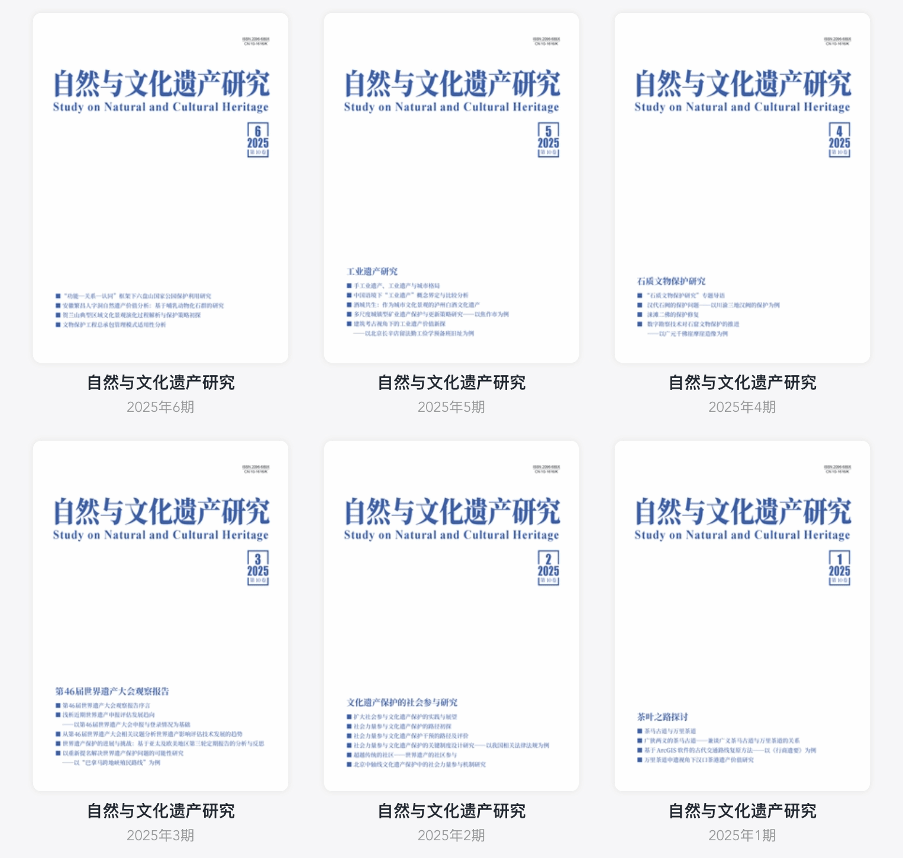
Cover images of Nature and Cultural Heritage Research Issues 1‑6, 2025
1. Published the Book A Reader of International Cultural Heritage Literature
In May 2025, the book A Reader of International Cultural Heritage Literature, co‑edited by Center Executive Director Li Guanghan and Researcher Wang Siyu, was successfully released.
2. Published the Journal Nature and Cultural Heritage Research
Six issues were published this year, featuring special topics including: Exploration of the Tea Road, Research on Social Participation in Cultural Heritage Protection, Observation Report on the 46th Session of the World Heritage Committee, Research on Stone Cultural Relics Protection, and Research on Industrial Heritage.
3. Enhanced the Communication Matrix
The Center’s new official website began construction in July, laying the foundation for expanding international communication channels.
The Center’s WeChat public account “Peking University Cultural Heritage Research” published 28 articles throughout the year, including the original column “Heritage Scholar Interview,” which garnered attention within the industry for its in‑depth content.
New Year Message
The various tasks undertaken by the UNESCO Asia‑Pacific World Heritage Training and Research Center (WHITR-AP) Beijing Branch in 2025 received positive responses in relevant fields both domestically and internationally, providing confidence for the Center to continue advancing research on world heritage protection and management, promoting exchanges and cooperation in the heritage field in the Asia‑Pacific region, and formulating its work plan for 2026.
The bell of the Year of the Bingwu Horse is about to ring. We extend our sincere gratitude to domestic and international partners, sister institutions, academic colleagues, and friends from all walks of life who have long cared for and supported the Beijing Branch. In the new year, the WHITR-AP Beijing Branch will continue to contribute its strength to the cause of heritage protection and the well-being of all humanity’s home!