From July 25 to July 28, 2021, the online course of the 2021 Joint Workshop on Cultural Heritage, jointly organized by the World Heritage Institute of Training and Research for the Asia and Pacific Region under the auspices of UNESCO (Beijing) and the School of Archaeology and Museology of Peking University, was successfully held. This workshop was co-chaired by three teachers: Zhang Jianwei, Wang Siyu, and Li Kuanghan.

Figure 1: Poster for the 2021 Joint Workshop on Cultural Heritage Conservation
With the goal of multidisciplinary collaboration in cultural heritage, in the summer of 2018, Professor Hang Kan of the School of Archaeology and Museology of Peking University and Professor Zhang Chaozhi of the School of Tourism Studies of Sun Yat-sen University jointly launched the Heritage Tourism Joint Workshop, initiating interdisciplinary dialogue and teaching exploration. In 2019, workshops on corresponding themes were successfully held in Donggeshan Village and Xigeshan Village, Pingyao County, Shanxi Province, and in 2020, in Huangguoshu, Anshun City, Guizhou Province. Building upon the foundation laid in the previous three years, the organizers have continuously adjusted and deepened the content and format of the workshop. This year, the theoretical foundation lectures were separated from the offline research, allowing for a more in-depth and focused approach in each component. The workshop invited experts from various related fields to engage in interdisciplinary discussions and lectures. The originally planned fieldwork, using the Taihe City Ruins in Dali as an example, aimed to conduct an exploratory study on the overall value and relevance of the Nanzhao and Dali historical sites through interpretation and exhibition design. Due to the pandemic, the fieldwork could not be conducted in person, and the online course portion was successfully carried out.

Figure 2: Professor Zhang Jianwei announces the start of the online course.
The workshop adopted an application and review system, with over 120 applicants, ultimately admitting 46 participants from 37 universities both domestically and internationally, including Harvard University, University College London, and Tsinghua University. The course was hosted by the School of Archaeology and Museology of Peking University, WHITR-AP Beijing, and the Dali Bai Autonomous Prefecture Culture and Tourism Bureau. It was funded by the Peking University Graduate School's "Postgraduate Education Innovation Program" and the Dali Bai Autonomous Prefecture Culture and Tourism Bureau. Professors from Peking University, Southeast University, Sun Yat-sen University, Quanzhou Normal University, and other universities, as well as experts and scholars in site conservation and architecture, were invited to teach the courses.
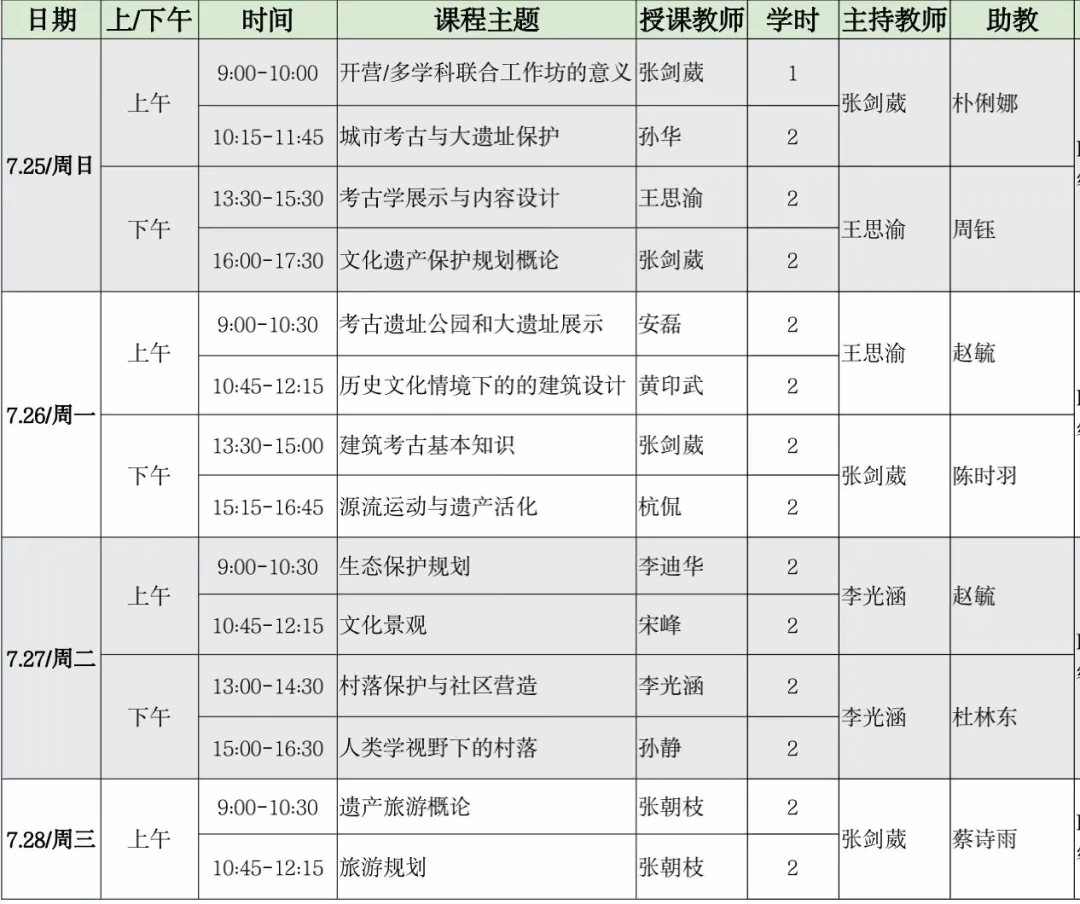
Figure 3: Workshop Schedule
The workshop lasted three and a half days and featured eleven professors and scholars. The course content was mainly divided into sections on large-scale site conservation, architectural archaeology, village heritage research, and heritage tourism. At the beginning of the course, Professor Zhang Jianwei announced the launch of this year's heritage workshop on behalf of the college, introduced the instructors, welcomed students, and discussed the significance of multidisciplinary collaboration in cultural heritage research and practice. In subsequent courses, Professor Sun Hua combined multiple case studies, emphasizing both theory and practice in teaching urban archaeology and the protection of major archaeological sites; Professor Hang Kan used the Origin Movement as an example to discuss pathways to heritage revitalization, opening up new perspectives for students and showing them a different side of the discipline of heritage; Professor Li Dihua taught ecological protection planning from a practical perspective, highlighting its strong relevance to natural heritage; Professor Song Feng, focusing on cultural landscapes, presented the importance of integrating nature and culture through conceptual analysis and concrete case studies; Professor Zhang Jianwei taught the fundamentals of cultural heritage protection planning and architectural archaeology, helping students establish relevant basic concepts; Professor Wang Siyu, combining archaeological exhibitions and site museums, taught content design methods for archaeological displays and exhibitions; and Professor Li Kuanghan, drawing on his fieldwork experience, delved into the theories and methods of village protection and community practice.
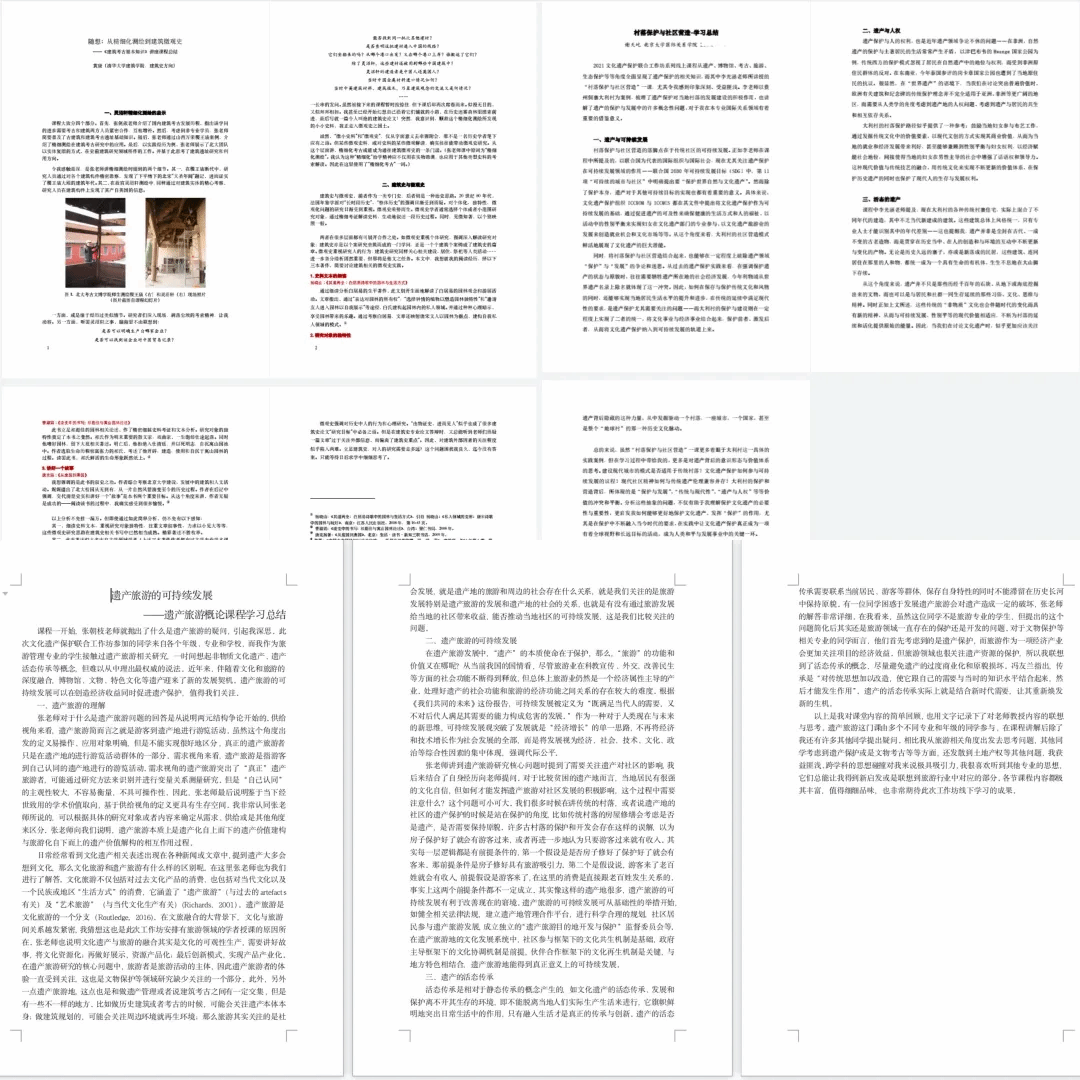
Figure 4 Excerpt of Final Assignments
The final assignments demonstrate that the multidisciplinary cultural heritage workshops provided students from various academic backgrounds with entirely new insights. Xie Tianyi, a student from the School of International Relations at Peking University, presented on village conservation. Drawing on his professional background, he outlined several key concepts in village conservation and community building, and incisively pointed out the critical issues facing the development of contemporary heritage conservation as a discipline: how to enable more diverse social groups to understand and value heritage conservation, and how to integrate heritage into a broader social development agenda. Huang Kang, a student from the School of Architecture at Tsinghua University, presented on architectural archaeology, discussing the relationship between history and architectural history, and raising the question of how far attention can be paid to the external aspects of architecture. He offered insightful reflections on disciplinary divisions, demonstrating meticulous reasoning and elegant writing. Chen Xing, a student from the School of Economics and Management at China University of Geosciences (Wuhan), presented on tourism management. Combining his professional background, he offered insights into the core value and sustainable development of heritage tourism, and connected this to the issue of living heritage transmission, highlighting interdisciplinary integration. Beyond enhancing their existing professional knowledge, the students broadened their horizons to other disciplines, gaining an understanding of different perspectives and methods regarding heritage perception and conservation. The workshop organizers have continuously refined their cultural heritage curriculum, and this year alone, they have conducted four sessions of the Peking University "Joint Cultural Heritage Workshop" summer program for graduate students. Students have undertaken research and interdisciplinary fieldwork in Henan and Hebei provinces, Pingyao in Shanxi province, Anshun in Guizhou province, and Dali in Yunnan province. The work in Anshun, Guizhou province, directly supported the application for World Heritage status for Huangguoshu Waterfall. Students have dedicated themselves to the country, enhancing their professional skills, gaining a deeper understanding of China's excellent traditional culture, and cultivating a spirit of hard work through practical experience. The teaching content and methods have been refined and distilled in this process. The workshop results in 2018 were published in the form of written discussion, which had a significant impact. They were included in the 2020 issue of "Renmin University of China Reprinted Newspaper and Periodical Materials: Cultural Studies". The article can be found in: [1] Zhang Jianwei, Gao Jun, Wang Xiongzhi, Ju Sasa, Xi Yaqing, Wang Siyu, Zhou Xiaofeng, Jin Yuhan, Yang Jiafan, Zhang Qian, Cui Kaiyi, Shu Peiyuan, "The Value, Protection, and Utilization of Heritage and Discussions Around Subjective Issues - Written Discussion of the First Joint Workshop on Heritage Tourism". Chinese Cultural Heritage, 2020(01):45-56.
[1] Zhang Jianwei, Gao Jun, Wang Xiongzhi, Ju Sasa, Xi Yaqing, Wang Siyu, Zhou Xiaofeng, Jin Yuhan, Yang Jiafan, Zhang Qian, Cui Kaiyi, Shu Peiyuan. “The Value, Protection, and Utilization of Heritage and Discussions Around Subjective Issues—A Discussion at the First Joint Workshop on Heritage Tourism.” Chinese Cultural Heritage, 2020(01):45-56.

Figure 5: Workshop results in 2018, published in Chinese Cultural Heritage.
In 2019, the possibility of integrating heritage, tourism, art, and other disciplines was explored in traditional villages in Pingyao. The report, exhibition, artworks and other achievements were displayed at the first Pingyao International Cultural Heritage Exchange Week, which received a warm response. The series of special reports organized by the organizer can be found in:
[1] Zhang Jianwei, Du Lindong, “Experiment and Solution of Interdisciplinary Joint Investigation on Rural Cultural Heritage Protection”. Chinese Cultural Heritage, 2020(04):4-11.
[2] Ma Qinglong, Zhang Jianwei*. “The Growth of Rural Heritage in Pingyao: An Observation Based on the Clustered Villages Near the Water in Front of the Mountain”. Chinese Cultural Heritage, 2020(04):33-43.
[3] Li Kuanghan. “Village Value from the Perspective of Everyday Landscape”. Chinese Cultural Heritage, 2020(04):12-19.
[4] Wang Siyu, Li Ying, Liu Hantao. “On the Significance of Village Social Survey in the Context of Village Heritage Protection”. Chinese Cultural Heritage, 2020(04):20-25.
[5] Chen Shiyu. “The Application of Constructing Future Scenario Planning that Transcends Reality in the Field of Cultural Heritage Management”. Chinese Cultural Heritage, 2020(04): 26-32.

Figure 6: Workshop results from 2019, published in Chinese Cultural Heritage
Report: Guo Huilan, “Our workshop was initially aimed at public participation.” People’s Daily Overseas Edition, August 12, 2019, page 11

Figure 7: Special report, published in People’s Daily
In 2020, the Huangguoshu area of Anshun, Guizhou Province, conducted basic data sorting and research for the Huangguoshu Tunpu World Heritage application, and carried out field investigations on Miao cave burials, Buyi villages, Tunpu, ancient roads, and more than 30 key cultural relics protection units. The research team has made a great contribution to the application for World Heritage status for Huangguoshu Tunpu by combining the first-hand data obtained from the workshop survey. The series of special articles organized by the organizer can be found in: [1] Zhang Jianwei. Humanistic landscape on karst landform - A guide to the phased results of the joint survey of Huangguoshu Tunpu heritage [J]. Research on Natural and Cultural Heritage, 2021, 6(04): 1-2. [2] Li Guanghan. Construction and integration - A preliminary exploration of Tunpu culture in Anshun, Guizhou from the perspective of heritage [J]. Research on Natural and Cultural Heritage, 2021, 6(04): 3-13. [3] Li Pengpeng, Li Guanghan. A study on the settlement morphology of Ximen Tunpu in Anshun - Taking Maguantun in Maguan Town as an example [J]. Research on Natural and Cultural Heritage, 2021, 6(04): 14-30. [4] Wang Siyu, Chen Shiyu. The current situation and characteristics of Buyi villages in Anshun, Guizhou Province—and the value issues in the protection of village heritage [J]. Research on Natural and Cultural Heritage, 2021, 6(04): 31-47. [5] Cai Shiyu. Heritage survey and research on the Anshun section of the ancient road between Hunan, Guizhou and Yunnan [J]. Research on Natural and Cultural Heritage, 2021, 6(04): 48-59. [6] Li Wanxin, Zhang Guanqi. Summary of the 2020 survey of the Liu Family Coffin Cave Burial Site in Anshun, Guizhou Province—a reflective discussion from an anthropological perspective [J]. Research on Natural and Cultural Heritage, 2021, 6(04): 60-67.


Figure 8 Workshop results in 2020, published in Research on Natural and Cultural Heritage
As Sun Hua said, "Traditional villages are a complex system, and protecting traditional villages and maintaining their vitality is also a complex system engineering project." Research on traditional villages requires interdisciplinary cooperation, and this applies to cultural heritage as well. Interdisciplinary collaboration requires supplementing general knowledge and expanding common ground to provide a foundation for cross-disciplinary dialogue. Based on this, it involves seeking common ground through problem-driven approaches, and finding the union of historical and future perspectives, as well as global and individual perspectives, to achieve connections and integration. The shift from differentiation to integration of human knowledge as a whole refers to the interconnected integration of knowledge to address a wide range of future problems, building upon existing advancements in productivity and the division of labor. In specific cultural heritage protection research and practice, the fundamental issue lies in how to effectively collaborate across multiple related disciplines, truly overcoming the incommensurability inherent in multidisciplinary collaboration. This is the original intention and greatest significance of holding multidisciplinary joint cultural heritage workshops.