Theme
The Preservation, Utilization, and Transmission of Linear Heritage
Moderator
Zhou Xiaofeng
Panelists
Wang Shaohan, Xu Niao, Han Quan
Date & Location
December 26, 2021, Shanshui Lounge
Participants
[In-person]
Wang Siyu, Li Kuanghan, Zhang Lisheng, Xie Li, Duan Niudou,
Park Lina, Du Lindong, Wang Shaohan, Han Quan, Sun Xiaopeng
[Online]
Zhou Xiaofeng, Sun Jing, Yan Haiming, Fu Shulan, Shen Ruiwen,
Xu Niao, Zhou Mi, Liu Yunxiao, Wang Shaocheng
See the end of the article for detailed profiles of all participants
▼
Abstract
The salon primarily focused on the definition, significance, and practical applications of linear heritage. The moderator and guests each addressed the topic through four case studies—the Great Wall, the Silk Road, the Camino de Santiago, and the Grand Canal—to discuss issues such as the definition of linear heritage, the interpretation of its value, tourism utilization, and conservation management. It was concluded that: the dissemination and transmission of the value of the Great Wall as a linear heritage require the establishment of a unified, holistic framework for recognizing its value; achieving transnational coordinated management and cultural cooperation for the Silk Road heritage requires, from a cross-cultural perspective, a rediscovery of the cultural commonalities among the relevant nations; the tourism utilization of the Camino de Santiago is characterized by balancing authenticity and commercialization, the application of cultural symbols and the reconstruction of cultural landscapes, ritual innovation, and community participation; and the Grand Canal faces issues of unequal discourse power in heritage interpretation regarding the shaping of cultural tourism. Subsequently, the discussion addresses the contradictions between the grand concept of linear heritage and its concrete practices, along with corresponding strategies; the relationship between its transnational characteristics and the international landscape; issues regarding coordination and management mechanisms and possibilities for improvement; and the neglect or weakening of local cultures in conceptual construction and value interpretation.
Keywords:
Holistic; Value; Concept; Conservation;
Utilization; Discourse; Official; Non-official
【Discussion】
Practices of Linear Heritage and Coordination Mechanisms
The Relationship Between Linear Heritage and Tourism
Conceptual Construction and Interpretation of Linear Heritage
【Introduction】
Linear Heritage and the Transmission of Value in the Great Wall of China
Understanding the Heritage Value of the Silk Road
Tourism Utilization of the Camino de Santiago
Tourism Utilization of the Cultural Heritage of the Grand Canal of China
▲
Linear Heritage and the Transmission of Value in the Great Wall of China
Zhou Xiaofeng:
● Why Discuss the Protection, Utilization, and Transmission of the Value of Linear Heritage

▲ The Evolution of World Cultural Heritage Conservation
Credit: Zhou Xiaofeng
1.The trend toward “linear holistic conservation” of cultural heritage on a large scale and across regions.
From the perspective of World Heritage, the objects of cultural heritage protection have shifted from the monuments, sites, and architectural complexes of 1972 to a variety of new types, including historic centers and districts, cultural landscapes, intangible cultural heritage, heritage canals, heritage routes, serial heritage, and transboundary heritage. The scope of protection has also shifted from emphasizing the physical preservation of individual sites to the protection of both the heritage itself and its surrounding environment, the protection of cultural and natural values, the protection of tangible and intangible cultural heritage, and regional holistic conservation. On the other hand, the increasing number of large-scale, cross-regional cultural heritage sites inscribed on the World Heritage List reflects a trend toward dynamic and holistic World Heritage conservation. At the national heritage level, conservation practices such as the Heritage Corridors in the United States, the National Trails in the United Kingdom, the Historical and Cultural Trails in Japan, and the development of National Cultural Parks in China demonstrate that a regional, linear approach to cultural heritage conservation—linking diverse ecological and cultural elements to form a unique, integrated whole—is gaining increasing prominence.

▲ Evolution of Cultural Heritage Conservation in China
Credit: Zhou Xiaofeng
2. The linear integrated development model for heritage utilization has significant comprehensive effects in driving heritage conservation as well as socio-economic and cultural development.
We can observe this through the development history of various types of tourism routes in France and Europe. The first phase was the development of the Alsace Wine Route in the 1950s, which gave rise to walking and self-driving tourism routes centered on other food and historical figures in the 1980s and 1990s. In particular, the European Cultural Routes project, launched in the 1980s, greatly promoted European cultural integration and strengthened the cultural identity of European citizens. To date, it has established 45 cultural routes across five themes: religious heritage, art and architecture, history and artifacts, landscapes and crafts, and industrial and scientific heritage. In addition to developing tourism routes primarily based on walking and driving, Europe has also developed cycling routes. For example, the Loire Cycle Route in France connects the entire World Cultural Heritage site: the Castles of the Loire Valley. In recent years, following the introduction of the concept of “all-for-one tourism” at the central government level, regions along the Great Wall have also rolled out new initiatives integrating culture and tourism, such as the construction of the Great Wall Tourism Highway, the Great Wall Tourism Zone, and the Great Wall Cultural Belt. The current development of the National Cultural Park, which spans 15 provinces and municipalities along the Great Wall, has become a new model for the protection and utilization of cultural heritage both now and in the future.

▲ Evolution of Heritage Value Perception from the Perspectives of Global and Chinese Authoritative Heritage Discourse
Credit: Zhou Xiaofeng
3. The complete transmission of heritage value requires the implementation of the concept of linear heritage.
At the international level, the focus of heritage value transmission has shifted from the Outstanding Universal Value of World Heritage sites to cultural significance at the local level, and now emphasizes the holistic value of the entire heritage system. In China’s authoritative heritage discourse, although the understanding of heritage value has not yet shifted to the holistic value of the heritage system, the overall trend in heritage practices indicates that the complete and authentic transmission of heritage value is the fundamental motivation for heritage conservation and utilization. For example, the 2019 “Master Plan for the Protection of the Great Wall” explicitly states that showcasing and transmitting the heritage values of the Great Wall is the core objective of Great Wall conservation and utilization efforts in the new era. The 2021 “Construction and Protection Plan for the Great Wall National Cultural Park” clearly sets forth the fundamental working principle of presenting the “overall image” of the Great Wall, aiming to establish the Great Wall National Cultural Park as a significant symbol for “promoting the national spirit and passing on Chinese civilization.” Therefore, against the new backdrop of national cultural park development, the mission of Great Wall heritage work is not merely to promote the deep integration of culture and tourism in China, enhance national cultural confidence and national identity, or foster the socio-economic development of regions along the route; its most important mission is to authentically and accurately disseminate and transmit the holistic value of the Great Wall.
In summary, the significance of currently advancing the value protection, utilization, and transmission of linear heritage lies in the following: (1) Linear heritage aligns with mainstream trends in large-scale, cross-regional cultural heritage protection both domestically and internationally; (2) Linear heritage represents a sustainable utilization model achieved through protection corridors, integrated zones, cross-industry integration, and cross-cultural exchange, which helps promote sustainable development; (3) Linear heritage can respond to the demands for the transmission of the overall value of heritage, both now and in the future.
● What is Linear Heritage?
The concept of “linear heritage” is a locally developed concept proposed by Chinese scholars based on the American concept of “heritage corridors” and ICOMOS's concept of “cultural routes.” First proposed by Shan Jixiang, it refers to a cluster of tangible and intangible cultural heritage located within a linear or strip-shaped area possessing a collection of special cultural resources. Often formed for specific human purposes, it serves as an important link connecting previously unconnected towns or villages, forming a chain-like state of cultural remains. It authentically reflects the historical movement of human activities and the exchange and interaction of tangible and intangible cultures, and endows these sites—as important carriers of cultural heritage—with humanistic significance and cultural connotations” [1]. Subsequently, domestic scholars applied the concept of linear heritage to large-scale, cross-regional cultural heritage research and practice, primarily treating linear heritage as a specific heritage category and emphasizing its heritage attributes and objectives. However, in subsequent discussions, linear heritage has evolved beyond being merely a distinct category of cultural heritage to encompass a conceptual framework for regional development. It now emphasizes the close interconnection between heritage conservation and socio-economic and cultural development, forming a conceptual cluster centered on heritage corridors and cultural routes [2].
Currently, linear cultural heritage represents an innovative concept in China’s cultural heritage conservation and development. As an overarching concept centered on cultural routes and heritage corridors, it carries three-tiered implications: as a category of heritage, as a philosophy and methodology for heritage conservation, and as a philosophy and methodology for heritage tourism development. Therefore, our understanding of the “linear” aspect of linear heritage should not be limited to spatial forms such as bands, lines, or chains; rather, it should focus on identifying specific bonds or central themes to connect dispersed tangible and intangible, natural and cultural heritage across large-scale, transregional areas, thereby achieving holistic conservation and comprehensive transmission.
● How to Transmit the Value of Linear Heritage: A Perspective Based on Value Dissemination at the Great Wall Museum
In recent years, as the focus of Great Wall heritage work has shifted from conservation to conservation, utilization, and transmission, the role of Great Wall museums in communicating heritage value has become increasingly important. Faced with the vast and rich Great Wall linear cultural heritage, museums—as key venues and media for heritage value dissemination, as well as the most authoritative communicators of heritage value—must address the core issue of how to comprehensively and accurately convey the Great Wall’s holistic heritage value to the public, thereby enhancing public recognition of its value, national identity, and cultural identity.
Since the establishment of the Tianjin Huangyaguan Great Wall Museum in 1986, museums at Great Wall heritage sites such as Jiayuguan, Shanhaiguan, and Badaling have also been successively completed in the early 1990s. According to the China Great Wall Protection Report, there were eight specialized Great Wall museums and exhibition halls in China in 2016. Our incomplete statistics indicate that there are currently approximately 27 specialized and non-specialized Great Wall museums in China, primarily distributed across four regions: Gansu, Ningxia, Hebei, and Beijing. In recent years, the construction and renovation of Great Wall museums have continued. With the deepening advancement of the Great Wall National Cultural Park project, Great Wall heritage tourism sites have not only witnessed a surge in museum renovations (such as the renovation and upgrade of the Badaling Great Wall Museum, scheduled for completion in 2023) but also a boom in new museum construction (such as the Jinshanling Natural History Museum and the Shanhaiguan Great Wall Cultural Museum, both currently under construction) . However, while the construction of Great Wall museums is in full swing, research on the dissemination of their value has long lagged behind. Currently, there are no comprehensive or systematic research findings on this topic, and existing efforts fail to meet the needs of communicating the Great Wall’s overall value. Therefore, how to promote the comprehensive and systematic dissemination and transmission of the Great Wall’s cultural heritage value has become a critical issue that cannot be avoided in both current and future Great Wall research.
To address this issue, we must first define “what constitutes the overall heritage value of the Great Wall.” By reviewing the perspectives of domestic and international experts and scholars, as well as relevant heritage convention and policy documents on cultural heritage value, it becomes evident that the understanding of cultural heritage value is highly diverse and complex. It encompasses various dichotomous value types—such as tangible and intangible, intrinsic and extrinsic, and core and derived values—as well as multifaceted value categories including historical, artistic, scientific, cultural, emotional, and economic dimensions. Through semantic network analysis, it has been identified that historical value, aesthetic value, scientific value, cultural value, and artistic value constitute the core essence of cultural heritage value. By reviewing the perspectives of experts and scholars, as well as domestic policy reports and planning documents regarding the cultural heritage value of the Great Wall, it becomes evident that the connotations of the Great Wall’s heritage value are also multifaceted. They encompass not only traditional values such as historical, scientific, and artistic value but also extend to include aesthetic value, landscape value, tourism value, social value, and economic value.

▲Diverse Perspectives on the Heritage Value of the Great Wall
Credit by Zhou Xiaofeng
Since 2018, with support from the research project “Great Wall Conservation and Public Access” at the China Cultural Heritage Research Institute, a heritage tourism team led by Professor Zhang Chaozhi of the School of Tourism at Sun Yat-sen University has surveyed Great Wall heritage sites across different regions, forms, and historical periods within China. Through questionnaires, interviews, and focus group discussions, the team has gathered insights into the perceptions of the Great Wall’s heritage value held by diverse groups, including tourists, business operators, managers, local residents, and experts. By conducting semantic network analysis of these diverse perspectives alongside existing textual sources on the Great Wall’s heritage value, the study identified historical, social, scientific, cultural, artistic, and spiritual values as the core components of the Great Wall’s heritage value. By integrating the macro-level framework for recognizing cultural heritage value with the specific core elements of the Great Wall’s heritage value, and drawing on the five value dimensions of “science, history, aesthetics, spirituality, and society” outlined in the Bala Charter, a more unified framework for recognizing the overall value of the Great Wall was proposed. This framework specifically comprises five dimensions: historical value, scientific value, aesthetic value, spiritual value, and social value, with social value further subdivided into sociocultural value and socioeconomic value.

▲ Cognitive Framework for the Overall Heritage Value of the Great Wall
Credit: Zhou Xiaofeng, Zhang Zhaozhi. Development of a Scale and Dimensional Structure for the Cultural Heritage Value of the Great Wall [J]. Chinese Cultural Heritage, 2020, (6): 4-14
The above represents a perspective from the Great Wall Museum on addressing the issue of value transmission for linear heritage: namely, establishing a unified conceptual framework capable of guiding the communication of the overall value of linear heritage.
Understanding the Heritage Value of the Silk Road
Wang Shaohan:
Today, I would like to discuss the unique academic value of Silk Road cultural heritage, specifically how it inspires us to re-examine the interpretive work surrounding transnational serial heritage.
In his 2015 article “Heritage Diplomacy,” Tim Winter conducted an interdisciplinary discussion of Silk Road cultural heritage from a cross-cultural perspective, arguing that the geo-cultural attributes of Silk Road cultural heritage hold untapped potential for facilitating exchange and cooperation among different regions and nations. In their article “The Maritime Silk Road: The Knowledge Production of a Cultural Heritage Concept,” Zhao Yun and Yan Haiming redefine the “Maritime Silk Road,” pointing out that it also offers us an opportunity to re-examine the issue of discourse power among countries along the serial heritage route regarding the definition of heritage.
The Silk Road is not merely a single linear heritage site but a collection of multiple linear heritage sites—a network of routes—a fact directly reflected in the World Heritage designation “The Silk Road: The Routes Network of the Chang’an-Tianshan Corridor.” In today’s era of deepening globalization, research on Silk Road cultural heritage has also entered a broader sphere of discourse. Since the late 20th century, UNESCO has maintained that the historical and cultural connections and cross-cultural exchanges along the Silk Road require greater international attention. In the conservation of linear cultural heritage, UNESCO has consistently upheld the concept of achieving transnational coordinated management. This is an extremely idealistic vision; the state of transnational coordinated management during and after the inscription of “The Silk Roads: The Routes Network of the Chang’an-Tianshan Corridor” demonstrates that realizing this vision will face numerous challenges. After observing and analyzing the World Heritage site “Prehistoric Lake-Shore Pile Dwellings in the Alps,” Adie et al. argued that differences in the policy environments among nations render the supranational management of serial transboundary heritage a utopian ideal, which imposes a negative domino effect on the sustainable use and tourism planning of such heritage [3].
● Methodological Issues in Interpreting the Essence of the Silk Road
My doctoral advisor, Professor Tim Williams of University College London, was commissioned by UNESCO and ICOMOS to conduct a thematic study on the roads along the Silk Road at the outset of the nomination project. His book, The Silk Roads: An ICOMOS Thematic Study, later provided guidance for resolving technical issues—such as the grouping of heritage sites and the practical methods of nomination—within the “Silk Roads Transboundary Nomination Series.” However, this study did not resolve the issue of interpreting the essence of the Silk Roads, leaving it to the participating nations.
A review of the nomination texts reveals that the interpretive texts on the Silk Road prepared by individual countries reflect distinct national perspectives. For example, China’s interpretation directly draws on historical records of the entire Silk Road from sources such as the Encyclopedia of China and the Records of the Grand Historian, centering on the Central Plains region and specifically using ancient place names such as “Western Regions,” “Dawan (Ferghana Basin)” to denote present-day Central Asia or specific locations within it. In contrast, the explanatory text provided by Kyrgyzstan centers on its own heritage sites, using the English spellings of modern Central Asian place names to illustrate how these regions participated in trade activities along the Silk Road.
While the examples mentioned here may appear to be a simple discrepancy in the selection of geographical terms, what they reveal is our adherence to specific value orientations and historical perspectives regarding “local culture” in transnational cultural cooperation. This further reinforces the binary division between “self” and “other” in international cooperation between China and Central Asian countries, and is also the root cause of the interpretive discrepancies in the “Silk Road: Chang’an-Tianshan Corridor Road Network.”
In recent research, some scholars have proposed that interculturality can serve as the logical starting point for advancing cultural cooperation among Silk Road-related nations. By linking the cultural memories of countries along the Silk Road, it aims to foster modern and trans-regional identities through “aesthetic innovation” [4]. The significance of interculturality lies in breaking free from the long-held mindset that the “Silk Road” constitutes a “shared memory” among the nations along its route. However, while the cognitive logic of interculturality recognizes the “hybridity” between cultures, it has not yet transcended the dichotomous perspective of “indigenous culture” versus “other culture.” The divergence in Silk Road narratives stems precisely from the distinctions and emphases placed on “self” and “other” by different interpretive perspectives.
The Silk Road itself was jointly constructed by different ethnic groups, cultures, and regions; it is a product of the exchange and interconnection of heterogeneous cultures [5], making cross-culturalism and cultural diversity its enduring historical characteristics. At the same time, while the history represented by the Silk Road actually occurred, the concept itself is a constructed one. Historical texts from relevant countries and regions document economic and cultural exchanges with neighboring areas, yet no route has ever been explicitly named the “Silk Road.” Influenced by the cultural and historical contexts of their respective nations and regions, the same place name may be referred to by different terms in different countries, and the same historical episode can become several entirely distinct narratives when viewed from different national perspectives [6].
Following the successful inscription, the achievement of a shared goal among nations undermined the previously established consensus on the interpretation of the “Silk Road’s” essence. Consequently, although heritage sites have been labeled as “Silk Road Heritage,” they continue to exist in the fragmented state they were in prior to inscription. Under UNESCO’s plan, the aim is to use the inscription as a starting point to establish a shared international “Silk Road” brand, thereby reigniting dialogue among civilizations and uncovering new opportunities for cooperation. However, entrenched cultural notions of “self” and “other” have led nations to view international cultural cooperation related to the “Silk Road” as a crucial opportunity to highlight their “national brands” [7].
● Interculturalism: The Logical Foundation of the Silk Road’s Public Cultural Space
Cross-border cooperation centered on the “Silk Road Series of Transnational Cultural Heritage” must first identify commonalities among the historical memories of different nations, and then showcase the cultural distinctiveness of various regions on the basis of these commonalities. The theory of interculturalism has not departed from Herderian cultural holism; it implicitly maintains a boundary between indigenous and foreign cultures. This is why I believe that redefining the essence of the Silk Road through the theory of interculturality still fails to break free from the inherent logic of cultural belonging among nations.
The German postmodern philosopher Welsch proposed the concept of “transculturalism” at the end of the 20th century, arguing that with the advancement of information technology and the development of globalization, the cultural lives of contemporary people have exhibited distinct transcultural attributes, and the boundary between “self” and “other” no longer exists [8]. From a historical perspective, the Silk Road propelled the early globalization of human society. Individuals and societies in the relevant regions, through the continuous exchanges along the Silk Road, lived for extended periods in a transcultural atmosphere, and a pluralistic cultural identity became a shared characteristic of the Silk Road’s early inhabitants. Therefore, the essence of the “Silk Road” points to a collection of cultural memories from the relevant nations, and “transculturalism” is the shared theme of these memories. Seeking commonalities in the cultural memories of Silk Road nations is tantamount to reconstructing the connections between cultures. This requires us to respect cultural differences while piecing together and integrating memories across different geographical spaces, ultimately establishing a “Silk Road Public Cultural Space” that belongs to the nations along the route.
In summary, reexamining the cultural significance of the Silk Road from a cross-cultural perspective involves understanding the cultural integration and interactions that occurred among the regions through mutual exchange as a network rather than a linear sequence. The cultural relationships—whether strong or weak—that exist between these regions serve as fundamental evidence of the Silk Road’s existence and are key to the formation of the “Silk Road Public Cultural Space.”

▲ Comparison of Interculturality Theory and Transculturalism
Credit: Wang Shaohan
Tourism Development of the Camino de Santiago
Xu Niao:
● The Camino de Santiago de Compostela
The Camino de Santiago is a network of religious and cultural heritage routes connecting various European countries to the Cathedral of Santiago de Compostela in northern Spain, the burial site of the remains of St. James, an apostle of Jesus. The Camino de Santiago comprises numerous branches; its “French Way” branch was inscribed on the World Heritage List in 1993. Spanning five autonomous communities in Spain, it is the most representative of all the pilgrimage routes. Regarding the “French Way” branch, we have identified two research questions: the modes of utilization of the pilgrimage route, and the role played by tourism management agencies in the utilization of cultural heritage.
● Utilization of Cultural Heritage Routes: Utilization of the Pilgrimage Route, Cultural Symbols, and Religious Rituals
In terms of route utilization, tourism management agencies have preserved the authenticity of heritage sites to the greatest extent possible. For example, the current French Way route draws upon the Codex Galisus, the first medieval guidebook for pilgrims. On the other hand, during tourism development, management agencies also create “authentic” experiences for stakeholders involved in heritage preservation. The entire walking route of the pilgrimage trail retains its original dirt paths, without any modern pavement repairs or expansions. Furthermore, visitors will not encounter an excessive number of modern shops along the way. Most shops along the French Way are concentrated in the towns through which the pilgrimage route passes. While this may cause some inconvenience to visitors, interviews revealed that these rustic, unspoiled paths and limited commercial activity actually satisfy visitors’ psychological need to “escape the mundane world,” thereby continuing the spirit of “asceticism” inherent in the pilgrimage.

▲ The Codex of Galisthun, 12th century
Source: ICOMOS. The Route of Santiago de Compostela No. 669[R]. Spain: ICOMOS, 1992:64.
In terms of the utilization of cultural symbols, management agencies primarily focus on the continuity of symbolic meaning, the improvement of dissemination channels, and the development of new forms of communication. The Pilgrimage Route features numerous representative cultural symbols, including “St. James,” “yellow arrows,” “geese,” and “the Holy Cross symbol.” These cultural symbols appear in various forms along the pilgrimage route, including the visual identity system, signage, promotional materials, and tourist souvenirs. As representations and carriers of culture, these symbols—manifested as road signs, ground decorations, and seals—embody the cultural spirit of the pilgrimage route. Not only do they integrate seamlessly into the route’s landscape, but they also deepen pilgrims’ understanding of the route’s cultural heritage.

▲ Forms of Dissemination of St. James
Credit: Xu Niao. The Construction and Dissemination of Cultural Symbols: A Case Study of the World Cultural Heritage Site, the Camino de Santiago [J]. Journal of Cultural Studies, 2021(01):61-65.
In terms of the practical application of “religious rituals,” tourism management agencies place great emphasis on innovating traditional “rituals.” The Cathedral of Santiago de Compostela serves as the religious administrative hub of the Pilgrimage Route. Each year, the cathedral disseminates religious and cultural traditions associated with the Pilgrimage Route by regularly holding religious and cultural events, promoting information about the route’s history, culture, and art, while also providing spiritual support to pilgrims. The Cathedral also spearheaded the establishment of the Pilgrim’s Office and led the development of a “Pilgrim’s Stamp System.” Every traveler on the Pilgrimage Route can obtain a “passport” at the Pilgrim’s Office and collect stamps by checking in at inns, restaurants, and churches along the way. Upon completion of the route, pilgrims can use their passport to obtain the “Certificate of Compostela.” This system was inspired by the medieval practice of pilgrims collecting stamps as they passed through cities and customs checkpoints. The system not only fosters an “interactive” relationship with pilgrims but also motivates them to complete the route.
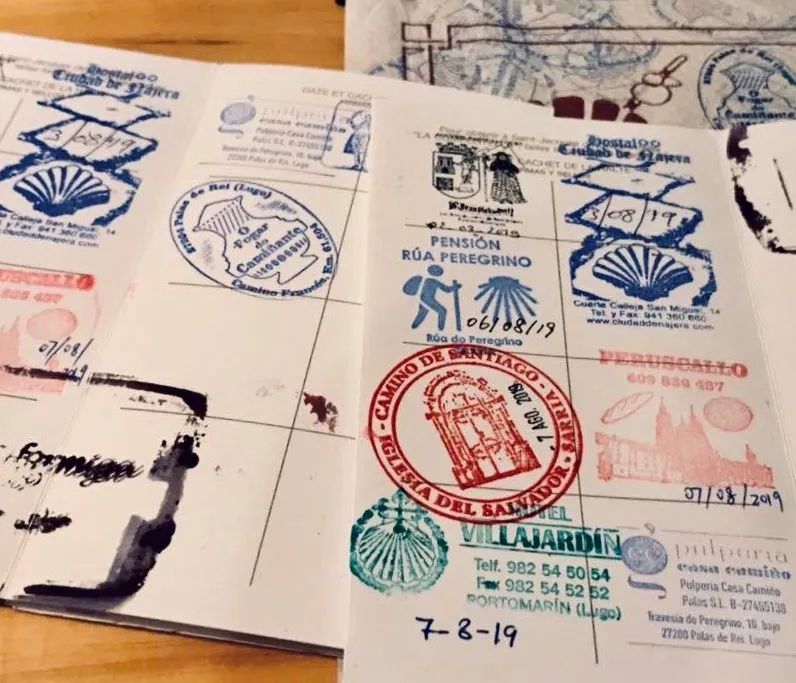
▲ Pilgrimage Route Stamp Passport
Credit: Xu Niao
● The Role of Tourism Management Organizations
Through an analysis of the management bodies overseeing the Pilgrimage Route, we have found that the route operates under a management system integrating government agencies, the Church, international organizations, and individuals. Different management bodies play distinct roles. For instance, regarding the protection of “authenticity,” we observed that the regional government plays a leading role. It has introduced a series of policies restricting land expansion and commercial development in towns along the route. Additionally, the Catholic Church is responsible for safeguarding the religious and cultural significance of the Pilgrimage Route, such as by regularly holding traditional ceremonies (including pilgrim Masses, incense rituals, and so on). Academic institutions also participate in interpreting and curating the history of the Pilgrimage Route, providing guidance for the development of pilgrimage tourism.

▲Tourism Management Framework of the Pilgrimage Route
Credit: Xu Niao and Qi Xiaoran
Through our research on tourism activities along the pilgrimage route, we have identified four key considerations regarding the utilization of linear cultural heritage. 1. Balancing the relationship between “authenticity” and “commercialization.” As seen in the pilgrimage route, its revitalization is premised on preserving “authenticity” rather than merely serving market value. For linear cultural heritage, the question we must address is how to ensure that a route retains its original character despite undergoing historical changes. 2. The application of cultural symbols and the reconstruction of cultural landscapes. For linear cultural heritage, its value lies not merely in a single point but in the route itself. By extracting cultural symbols, exploring their meanings, and refining their modes of dissemination, we can enhance tourists’ perception of the route’s integrity. 3. Promoting ritual innovation to create profound cultural experiences for tourists. Innovation in rituals stems from exploring the unique characteristics and values of the heritage route itself. Take pilgrimage as an example: in the Middle Ages, people typically viewed this ascetic practice as a means of “penance,” “healing illness,” and “redemption from original sin.” Consequently, today’s pilgrimage routes retain the length and methods of medieval pilgrimages (such as walking or riding horses), while also incorporating more contemporary modes of transportation, such as cycling. 4. Emphasizing community participation to foster residents with “cultural self-awareness.” During our visits to communities surrounding the pilgrimage routes, we found that local residents have a strong sense of identity and belonging toward the culture of these routes. Tourism management agencies provide opportunities for residents and volunteers to engage in and participate in the processes of cultural creation and dissemination.
Tourism Development of the Grand Canal of China Cultural Heritage
Han Quan:
● Regarding the Grand Canal of China Cultural Heritage
The Grand Canal was inscribed on the World Heritage List in 2014. Spanning eight provinces and municipalities, it traverses the five major river systems of eastern China and connects cultural regions such as Yan-Zhao, Qi-Lu, Liang-Hui, and Wu-Yue, making it a significant linear cultural heritage site in China. According to UNESCO’s description of the Grand Canal of China, it is the world’s oldest, largest, and longest canal. Its value is not only reflected in the fact that it represents the highest level of Eastern water conservancy and water transport engineering technology during the era of human agricultural civilization, but also in the culture of grain transport management across successive dynasties and the unique lifestyles of the people living along its banks. It vividly reflects the ancient Chinese philosophy of unity, complementarity, and integration, as well as human wisdom, determination, and courage.[9]
● How to Utilize the Cultural Heritage of the Grand Canal for Tourism
How can we utilize the cultural heritage of the Grand Canal for tourism while preserving its authenticity and integrity?
First, I would like to discuss the issue of heritage authenticity with you. The Ancient City of Tai’erzhuang in Zaozhuang, Shandong Province, serves as a representative case among the cities along the Grand Canal. Based on nearly two months of participatory observation and over 100 hours of interviews conducted by our research team last year, we found that the reconstruction project of the Ancient City of Tai’erzhuang can be divided into two phases: the preliminary planning and reconstruction phase, and the subsequent tourism operation phase. These two phases differ in their development priorities and driving forces.
Before its reconstruction, Tai'erzhuang was a marginalized, declining town, and the original site of the ancient city had already been earmarked for a real estate development project. Only a few elderly residents retained faint memories of the canal transport heritage preserved there. Following a feasibility study, the Zaozhuang Municipal Government decided to restore and rebuild Tai'erzhuang Ancient City, leading five local state-owned coal enterprises to form a joint venture to develop and construct the site. The construction process fully demonstrated the advantages of government-led development. For instance, driven by considerations of urban strategic transformation and the preservation of historical and cultural continuity, the canal heritage was fully preserved, and the historical character of the ancient town was restored to the greatest extent possible.

▲ Tai’erzhuang Ancient Town after reconstruction
Source: http://www.cctvmlgx.com/xinwenzixun/2017/0410/1709.html
After the main construction work was completed in May 2010, the focus of Tai’erzhuang’s development shifted to cultural exploration and tourism utilization. The government’s leading role gradually diminished, with the government primarily assuming the roles of protector of the canal heritage and supervisor of tourism operations. The management and operation of the scenic area were handed over to the Tai'erzhuang Ancient City Tourism Development Co., Ltd. At the same time, local residents have also become involved in the management of the scenic area, such as renting shops within the area to sell local specialties or performing intangible cultural heritage and folk customs. This has effectively preserved and showcased the culture of guild halls, merchant groups, and everyday life along the canal. Visitors also deepen their awareness, understanding, and appreciation of the canal heritage and culture by touring wharves, post stations, locks, and other hydraulic facilities, as well as participating in experiential activities such as night tours of Tai’erzhuang and rowing boat rides with local boatwomen. This market-oriented approach has revitalized the canal heritage, generating sustained tourism revenue for the local area and providing financial support for heritage conservation.
However, both phases have also been subject to some controversy. The controversy surrounding the first phase centered on whether the construction of the new ancient city would preserve the authenticity of the canal heritage and whether future residents would benefit from the economic gains of the ancient city. Since the local government strictly adhered to the reconstruction philosophy of “preserving, restoring, promoting, and utilizing the ancient,” this conflict was not particularly prominent. The complex interactions among stakeholders in the second phase have sparked numerous conflicts. First, because local residents were relatively marginalized during the reconstruction of Tai’erzhuang Ancient City, the government-led project resulted in a city that differs somewhat from the daily life familiar to residents. Second, managers have insufficiently explored Canal culture, and operators have limited understanding of it, making it difficult to achieve the original goal of disseminating heritage values. Under the combined influence of these two contradictions, genuinely authentic “living heritage” is easily concealed in informal, overlooked corners. This creates a disconnect between the cultural heritage itself, its interpreters, and its recipients, making it difficult to establish a temporal and spatial dialogue between the public and the heritage, and hindering the sustainability of heritage conservation and tourism development.

▲ Tai’erzhuang Ancient City Tourism Place-Making Model
Source: Han Quan (Image created by research team)
On the other hand, the “overall value of linear cultural heritage exceeds the sum of its parts,” making the concept of integrity crucial. Before presenting canal heritage to the public, managers must shape the brand image of Grand Canal cultural tourism from a holistic, macro perspective. That is, there must be both an overarching brand reflecting the value of canal heritage and regional brands capable of reflecting distinct local canal cultures and urban folk cultures. Only in this way can the brand image of destinations that tend toward homogenization be made more distinctive. Without brand system planning from a macro perspective, localities will spontaneously undertake their own brand positioning, which can easily lead to homogenization and make it difficult to reflect the “integrity” of the canal heritage.
The tourism utilization of linear cultural heritage involves presenting the heritage to the public through education and tourism while preserving its authenticity and integrity, thereby enhancing visitors’ sense of place and achieving the living preservation of the heritage. However, as I mentioned earlier, this process does indeed encounter issues such as unequal discourse power in heritage interpretation and insufficient heritage interpretation, which require further discussion.
The above remarks were revised on March 18, 2022.
-END-
Li Kuanghan. Assistant Director, WHITR-AP Beijing
Wang Siyu, Assistant Professor, School of Archaeology and Museology, Peking University
Duan Niudou, Lecturer, School of Humanities, Central Academy of Fine Arts
Xie Li, Associate Researcher, China Association for the Conservation of Cultural Heritage
Zhang Lisheng, Postdoctoral Researcher, Department of Sociology, Peking University
Du Lindong, Doctoral Candidate, School of Architecture, Tsinghua University
Park Lina, Project Officer, UNESCO World Heritage Training and Research Centre for the Asia-Pacific Region (Beijing)
Wang Shaohan, Postdoctoral Researcher, School of Arts (Institute of Cultural Industry), Peking University
Han Quan, Master’s Student, Institute of Chinese Culture and Tourism Industry, Beijing Second Foreign Studies University
Sun Xiaopeng, Doctoral Student, School of Architecture and Urban Planning, Beijing University of Civil Engineering and Architecture
Shen Ruiwen, Professor, School of Archaeology and Museology, Peking University
Zhou Xiaofeng, PhD Candidate, School of Tourism, Sun Yat-sen University; Visiting Scholar, School of Tourism Studies, Panthéon-Sorbonne University (Paris I)
Sun Jing, Associate Professor, Institute of Chinese Quanzhou Cultural Heritage, Quanzhou Normal University
Yan Haiming, Associate Researcher, China Cultural Heritage Research Institute
Fu Shulan, Associate Professor, School of Civil Engineering, Zhejiang University
Xu Niao, Lecturer, Sichuan University of Media and Communications
Zhou Mi, PhD Candidate, School of Architecture, Xi’an University of Architecture and Technology
Liu Yunxiao, PhD Candidate, Department of Archaeology, University College London
Wang Shaocheng, PhD Candidate, Department of Archaeology, University College London
The copyright for the layout of this article belongs to “Peking University Cultural Heritage Studies.”
All content is provided by the speakers themselves, and the copyright belongs to the speakers.