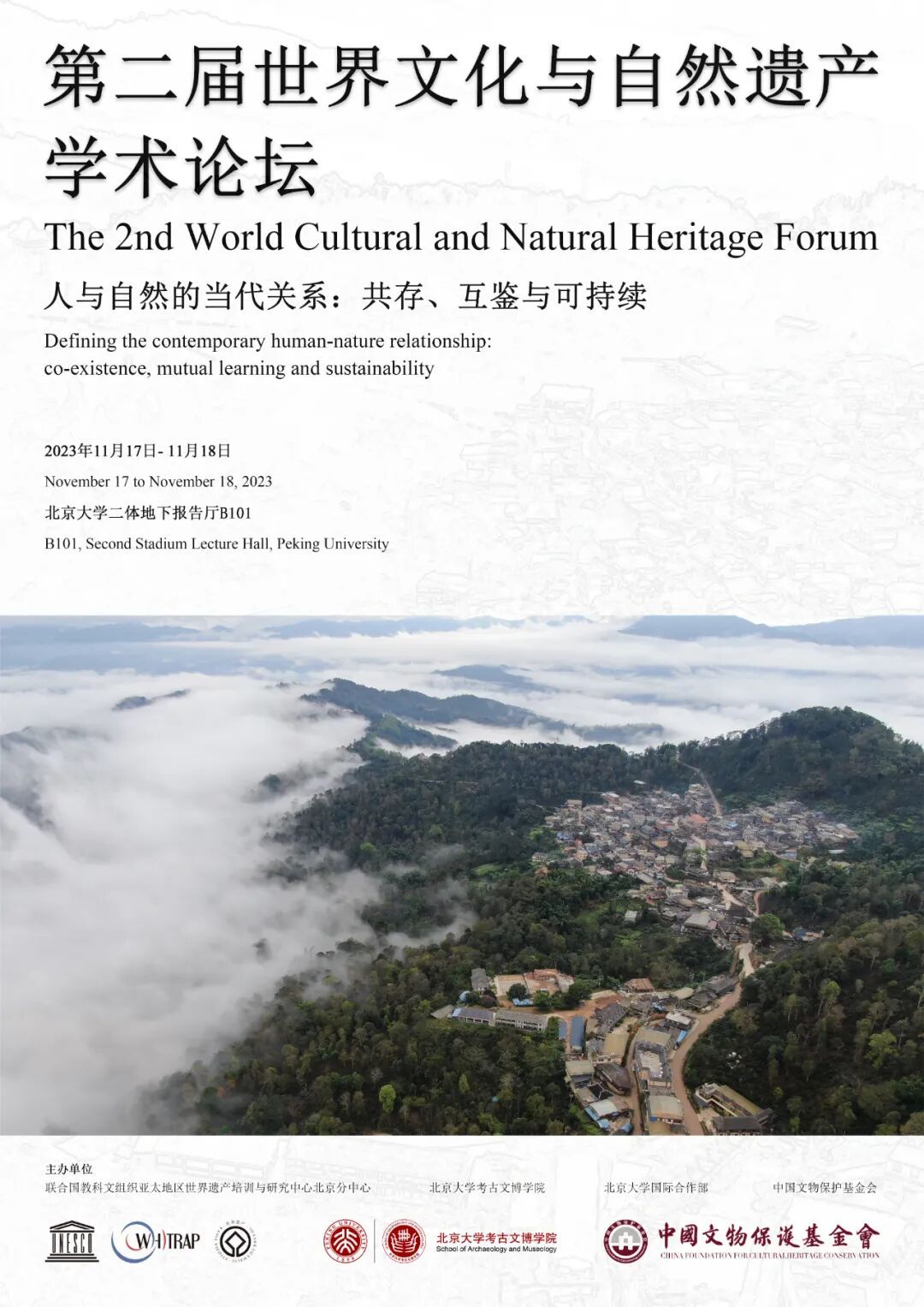

Forum Overview
World cultural and natural heritage represents key outcomes of human civilization and natural evolution, and serves as an important medium for dialogue and mutual learning among different civilizations. Protecting, transmitting, and appropriately utilizing these valuable assets is a shared responsibility and an essential requirement for the continuity of human civilization and global sustainable development.
Since the adoption of the 1972 Convention Concerning the Protection of the World Cultural and Natural Heritage, global society has undergone major changes, and our understanding of heritage has continuously evolved. Climate change, armed conflict, and the COVID-19 pandemic have become key issues of concern for world heritage. Within the broader context of global sustainable development, there is increasing recognition of the importance of the integration of nature and culture.
The discussions at the 44th World Heritage Committee session on “new relationships between people and nature” suggest the need to reconsider how cultural and natural integration can be developed under new global conditions. The inscription of China’s “Pu’er Jingmai Mountain Ancient Tea Forest Cultural Landscape” at the 45th World Heritage Committee session demonstrates a Chinese approach to harmonious coexistence between humans and nature.
Against this backdrop, building new forms of human–nature relationships and safeguarding humanity’s shared heritage for the future has become urgent.
Following the initiative of UNESCO and responding to China’s “Asian Cultural Heritage Protection Action” and the Global Civilization Initiative, the UNESCO World Heritage Training and Research Centre for the Asia-Pacific Region (Beijing), the School of Archaeology and Museology of Peking University, the China Foundation for Cultural Heritage Conservation, and the Office of International Cooperation at Peking University will jointly host the 2nd International Academic Forum on World Cultural and Natural Heritage from November 17 to 18, 2023.
Theme: The Contemporary Relationship Between Humans and Nature: Coexistence, Mutual Learning, and Sustainability
Organizational Structure
Organizers
UNESCO World Heritage Training and Research Centre for the Asia-Pacific Region (Beijing Branch) (WHITRAP Beijing)
China Foundation for Cultural Heritage Conservation
School of Archaeology and Museology, Peking University
Office of International Cooperation, Peking University
Co-organizers
UNESCO Chair on Sustainable Tourism in Heritage Sites
UNESCO Chair on Living Heritage and Community Development
UNESCO Chair on Cultural Resource Management
WHITRAP Shanghai Branch
WHITRAP Suzhou Branch
Peking University Public Archaeology and Art Center
Peking University Cultural Heritage Protection Research Center
Supporting Organization
Asian Cultural Heritage Protection Fund
Supervising Organization
Secretariat of the National Commission of the People’s Republic of China for UNESCO
Forum Agenda
Time
November 17–18, 2023
Venue
Underground Lecture Hall B101, Second Gymnasium, Peking University

November 17
Opening Ceremony
8:30–9:00
Host
Chen Jianli, Party Secretary and Professor, School of Archaeology and Museology, Peking University
Remarks
Secretariat of the National Commission of the PRC for UNESCO
Peking University
China Foundation for Cultural Heritage Conservation
Chinese Association for the Protection of Monuments and Sites
Relevant leaders
Session 1: Development Trends of World Heritage
Host: Zhang Jianwei (Peking University / WHITRAP Beijing)
9:00–9:20
Analysis of the Third Cycle of Periodic Reporting in the Asia-Pacific Region
Yang Bixing
Cultural Project Officer, UNESCO East Asia Multisectoral Regional Office
9:20–9:40
Upstream Guidance Before World Heritage Nomination: Objectives, Methods, and Challenges
Thomas Coomans
Professor, KU Leuven, Faculty of Engineering Science
9:40–10:00
Trends in Natural World Heritage Development
Song Feng
Associate Professor, School of Urban and Environmental Sciences, Peking University
Tea Break (10:10–10:30)
Session 2: Protection and Management of Archaeological Heritage Sites
Host: Li Wanyin, Associate Professor, Peking University
10:30–10:50
Endless Journey: Protection and Management of the Lost City Archaeological Park of Teyuna, Colombia
Santiago Giraldo
WMF Colombia Representative
10:50–11:10
Threats and Development: Climate Change and Buddhist Site Conservation in the Tarim Basin
Du Xiaofan
Professor, Fudan University
11:10–11:30
Large Archaeological Sites in Traditional Cultural Landscapes
Zhang Jianwei
Discussion (11:30–12:00)
Reviewer: Zhan Changfa
Lunch (12:00–14:00)
Session 3: Coexistence Between Humans and Nature
Host: Jiang Dahai, Peking University / WHITRAP Beijing
14:00–14:20
Coastal Connections: International Best Practices
Alexander J. Kent
14:20–14:40
Integrated Protection of Cultural and Natural Heritage in the Context of Climate Change: The Tianshan Case
Wang Xinyuan
14:40–15:00
Impact Assessment of Construction Projects on Natural World Heritage Sites in China
Xiao Shizhen
15:00–15:20
Pandas and Snow Leopards: The Role of Flagship Species
Lü Zhi
Tea Break (15:30–15:50)
Session 4: Protection and Utilization of Villages and Cultural Landscapes
Host: Li Dihua, Peking University
15:50–16:10
Value-Based Conservation of the Jingmai Ancient Tea Forest Cultural Landscape
Chen Yaohua
16:10–16:30
Chinese World Heritage under Cultural–Natural Integration
Zhang Rouran
Discussion (16:30–17:00)
Reviewer: Du Xiaofan
Youth Scholars Forum (17:30–21:00)
Host: Wang Siyu
Discussion participants include researchers from museums, universities, archaeology, sociology, and heritage management institutions.
Topics include:
·cultural tourism communication
·historical landscape systems
·ecological restoration
·heritage management transformation
·urban heritage evolution
November 18
Session 5: Historic Built Environment Protection and Utilization
Host: Li Guanghan (WHITRAP Beijing)
8:40–9:00
Heritage Protection in Pakistan: Problems, Challenges, and Limitations
Fauzia Qureshi
9:00–9:20
Water Towns and Mega-Cities: Nature and Culture in Global Cities
Shao Yong
9:20–9:40
Integrated Protection and Development of Cultural and Natural Heritage
Dong Wei
9:40–10:00
The “Doctrine of Moderation” in Urban Heritage Corridors
Dai Jian
Tea Break (10:10–10:30)
Session 6: Natural Heritage Protection and Community Development
Host: Song Feng
10:30–10:50
Authenticity in Natural Heritage: Practice and Reflection
Zhang Chaozhi
10:50–11:10
Community Development and Natural Heritage Management: Victoria Falls Case Study
John Zulu
11:10–11:30
Analysis and Insights on Natural World Heritage Site Conservation Status
Zhuang Youbo
Discussion (11:40–12:10)
Reviewer: Zhou Jian
Closing Ceremony (12:10–12:30)
Summary: Hang Kan, Peking University
Closing Remarks: UNESCO East Asia Regional Office Representative; Chen Jianli
Organizational Structure
Special Guests
Liu Yuzhu, President, China Foundation for Cultural Heritage Conservation
Song Xinchao, President, Chinese Association for the Protection of Monuments and Sites
Qin Changwei, Secretary-General, China National Commission for UNESCO
Xia Zehan, Representative, UNESCO East Asia Multisectoral Regional Office
Wang Ying, Director and Deputy Secretary-General, China Foundation for Cultural Heritage Conservation
Li Yun, Director, Office of International Cooperation, Peking University
Participants (ordered by speaking sequence)
Chen Jianli
Zhang Jianwei
Yang Bixing
Thomas Coomans
Song Feng
Li Wanyin
Santiago Giraldo
Du Xiaofan
Zhan Changfa
Jiang Dahai
Alex Kent
Wang Xinyuan
Xiao Shizhen
Lü Zhi
Li Dihua
Chen Yaohua
Zhang Rouran
Li Guanghan
Fauzia Qureshi
Shao Yong
Dong Wei
Dai Jian
Zhang Chaozhi
John Zulu
Zhuang Youbo
Zhou Jian
Hang Kan
Li Jianghai
Qi Xin
Youth Forum Participants
Ling Ming
Wang Siyu
Zhou Xiaofeng
Fu Shulan
Wen Cheng
Lü Ning
Zhou Mengyuan
Cai Shiyu
Yanhai Ming
Fan Jialing
Xu Tong
Zhang Xiaogu
Zhang Lisheng
Sun Jing
Chang Junfu
Heritage Site Managers Forum Participants
Di Yajing
Zhu Haijun
Fang Yuan
Ma Dongfeng
Shang Kong
Wang Jiao
Song Hongbing
Chen Zhenghua
Zhao Xiaomei
(plus additional listed officials from Fanjing Mountain, Taishan, Emei Mountain, Jiuzhaigou, etc.)
Editorial Team
Editors: Pu Lina, Lü Jiaxin
Reviewers: Li Guanghan, Wang Siyu
Final Review: Shen Ruiwen, Zhang Jianwei