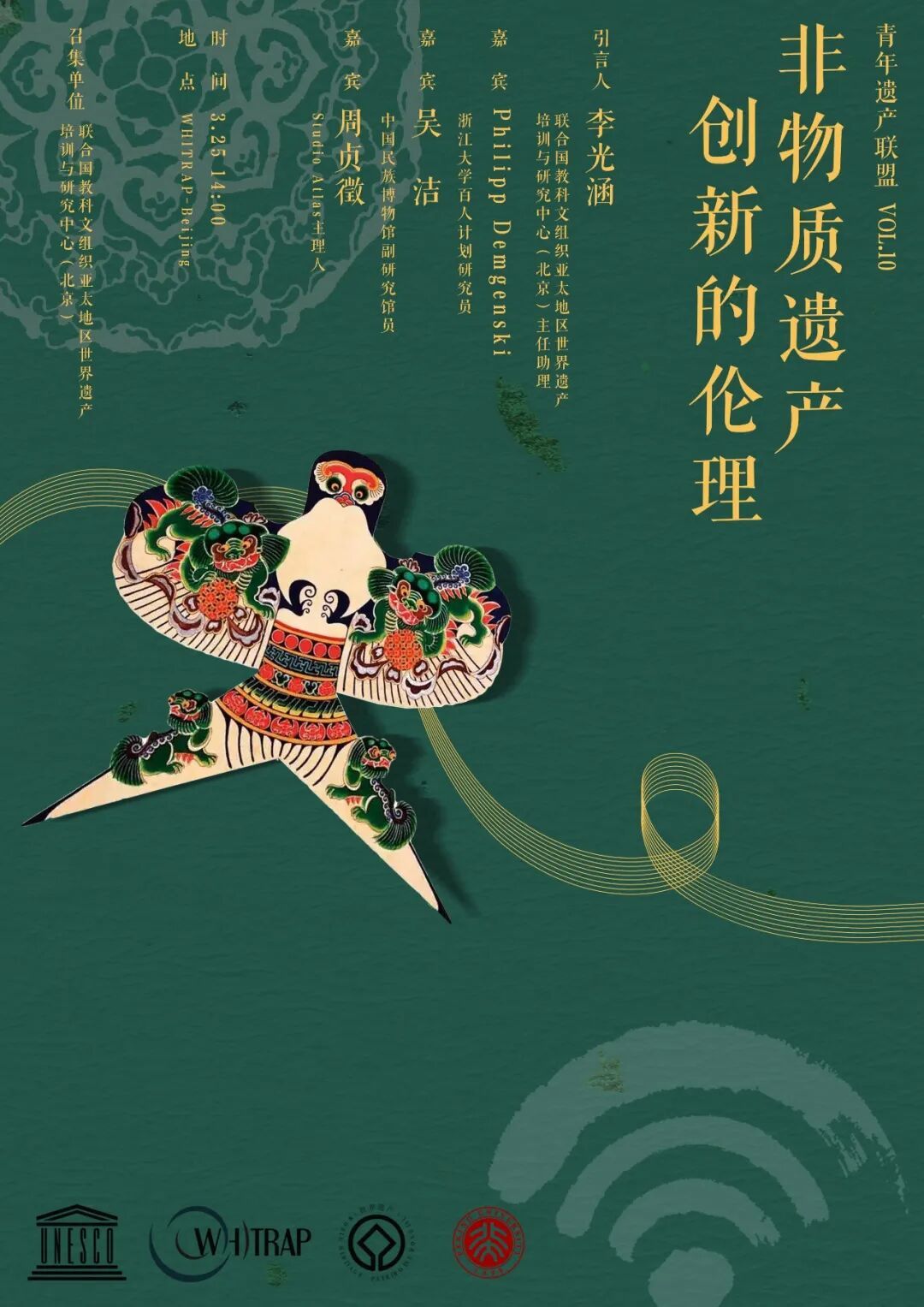
Theme
The Ethics of Innovation in Intangible Heritage
Moderator
Li Guanghan
Assistant Director, UNESCO World Heritage Institute of Training and Research for the Asia and Pacific Region under the Auspices of UNESCO (Beijing)
Time and Venue
March 25, 2022, 2:00 PM
WHITRAP-Beijing
Organizing Institution
UNESCO World Heritage Institute of Training and Research for the Asia and Pacific Region under the Auspices of UNESCO (Beijing)
Guests
Philipp Demgenski, ZJU100 Young Professor, Zhejiang University
Wu Jie, Associate Research Librarian, National Museum of Ethnology of China
Zhou Zhenzheng, Founder of Studio Atlas
▼
Background of the Initiative
WHITRAP-Beijing is committed to exploring the formation of contemporary heritage studies as an academic discipline.
As the heritage conservation movement continues to expand globally, many universities around the world are also striving to establish more independent heritage-related academic programs. However, because this development has largely been driven by conservation practice, today’s heritage studies remain highly practice-oriented and strongly interdisciplinary, still some distance away from a mature academic framework with clearly defined boundaries.
Against this backdrop, we hope to make use of the current diversity, openness, and spirit of breakthrough by inviting scholars from different disciplinary backgrounds to participate in this Youth Heritage Alliance.
Different disciplines may contain elements that are not fully compatible with one another, and perspectives on heritage may still be incomplete. Yet young scholars often inherit the traditions of their own disciplines while also bringing fresh ideas and a willingness to push boundaries.
We believe this is precisely where meaningful dialogue and intellectual exchange can occur, and where a clearer and more mature heritage discipline may emerge. The “Youth Heritage” academic salon series is an exploration developed within this context.
▲
▼
Composition of Members
The core academic group consists of young scholars from different disciplinary backgrounds related to cultural heritage.
Current core members come from fields including cultural heritage studies, museology, archaeology, architecture, urban and rural planning, anthropology, sociology, tourism studies, and art studies.
Members are affiliated with universities and institutions in China and abroad, including Peking University, Tsinghua University, Sun Yat-sen University, Zhejiang University, Central Academy of Fine Arts, KU Leuven, research institutes, museums, and related organizations.
▲
▼
Organization Method
An academic salon is organized every one to two months.
Each salon invites one scholar to serve as the moderator, who selects the theme and may invite guest speakers to participate in the discussion. After the moderator introduces the topic, free discussion is conducted in a salon format.
A designated recorder documents each salon discussion for archival purposes.
Based on the core members, participation in each salon is by invitation. Around ten participants attend in person, while those outside Beijing may join online.
After the salon concludes, discussion content will be整理ed and, depending on the value and substance of the discussion, may be published either as meeting transcripts on the “Peking University Cultural Heritage Research” WeChat public account or as written discussions in academic journals such as Nature and Cultural Heritage Research.
▲
▼
Previous Sessions
Review | Youth Heritage Salon Vol.1: Re-Critiquing Heritage Criticism (Part 1)
Review | Youth Heritage Salon Vol.1: Re-Critiquing Heritage Criticism (Part 2)
Review | Youth Heritage Salon Vol.2: Toward De-Secularized Heritage (Part 1)
Review | Youth Heritage Salon Vol.2: Toward De-Secularized Heritage (Part 2)
Review | Youth Heritage Salon Vol.3: The Echoes of Heritage
Review | Youth Heritage Alliance Salon Summary Vol.4 (Introduction): Value Protection, Utilization, and Transmission of Linear Heritage
Review | Youth Heritage Alliance Salon Summary Vol.4 (Discussion): Value Protection, Utilization, and Transmission of Linear Heritage
Review | Youth Heritage Alliance Salon Summary Vol.5: The Difference Between “Using” and “Viewing” — The Special Nature of Architectural Heritage Conservation
Review | Youth Heritage Alliance Salon Summary Vol.6: Telling China’s Cultural Heritage Stories: Official, Local, and Client Perspectives
Review | Youth Heritage Alliance Salon Summary Vol.7: The “Exemplarity” of Heritage Cities and the Sustainable Development of World Heritage Ecological Culture
▲
Poster Design: Zheng Zhaoqi