01 Teacher's Message
Professor Zhang Jianwei

The historical architectural resources of the Yantaishan group are relatively clear. The Yantaishan Management Committee provided substantial support in terms of documentation and on-site surveys, and there was also an excellent index from the Fuzhou Old Architecture Encyclopedia website. Therefore, although the group had a large number of historical buildings to investigate, the students, through division of labor, covered all of them within a few days. With this documentary foundation, the students were able to engage in deeper thinking: what kind of connections do these historical buildings in Yantaishan have with the Chinese and foreign figures and families in Fuzhou's history, as well as with today's communities? What kind of heritage is formed by the spatial history created by people and buildings, and by the networking of people through space? The group conducted in-depth social surveys, uncovering the stories and networks behind the historical buildings. In just a few days, they produced new knowledge in both architectural and social aspects—a truly gratifying outcome.
The Cultural Heritage Joint Workshop has now been held for five years, with growing experience in cross-disciplinary collaborative research, gradually developing a set of field teaching methods. As an organizer, nothing is more rewarding than seeing students achieve meaningful learning outcomes.
02 Work Summary
In just ten days of the workshop, we went from complete strangers to gradually becoming familiar, and finally to forging a "revolutionary friendship" through working together to complete our outcomes—a memory worth cherishing from the summer of 2022.

Anlan Guild Hall

Meizhi Building
From August 1st to 2nd, during the workshop's group activities, we visited Sanfang Qixiang (Three Lanes and Seven Alleys), Shangxia Hang (Upper and Lower Hang), Yantaishan, Guling, and Mawei Shipbuilding, initially building a holistic understanding of Fuzhou's urban history.

Meifeng Bank
From August 3rd to 5th, the group conducted in-depth research on the old buildings of Yantaishan, carrying out detailed surveys of the Lequn Road area, Maiyuan Road area, and Gongyuan Road-Machang Street area, while also conducting interviews and recordings with various groups of people. Through observation and recording of architectural form, date, structure, style, and function, we interpreted the historical, artistic, and scientific values embedded within. At the same time, social and cultural values were also important angles for weaving narratives—such as changes and connections in building ownership and usage, and the functional transformations of buildings as sites of events—helping us transform heritage from "extrinsic value-subjective value" toward "intrinsic value-objective value."
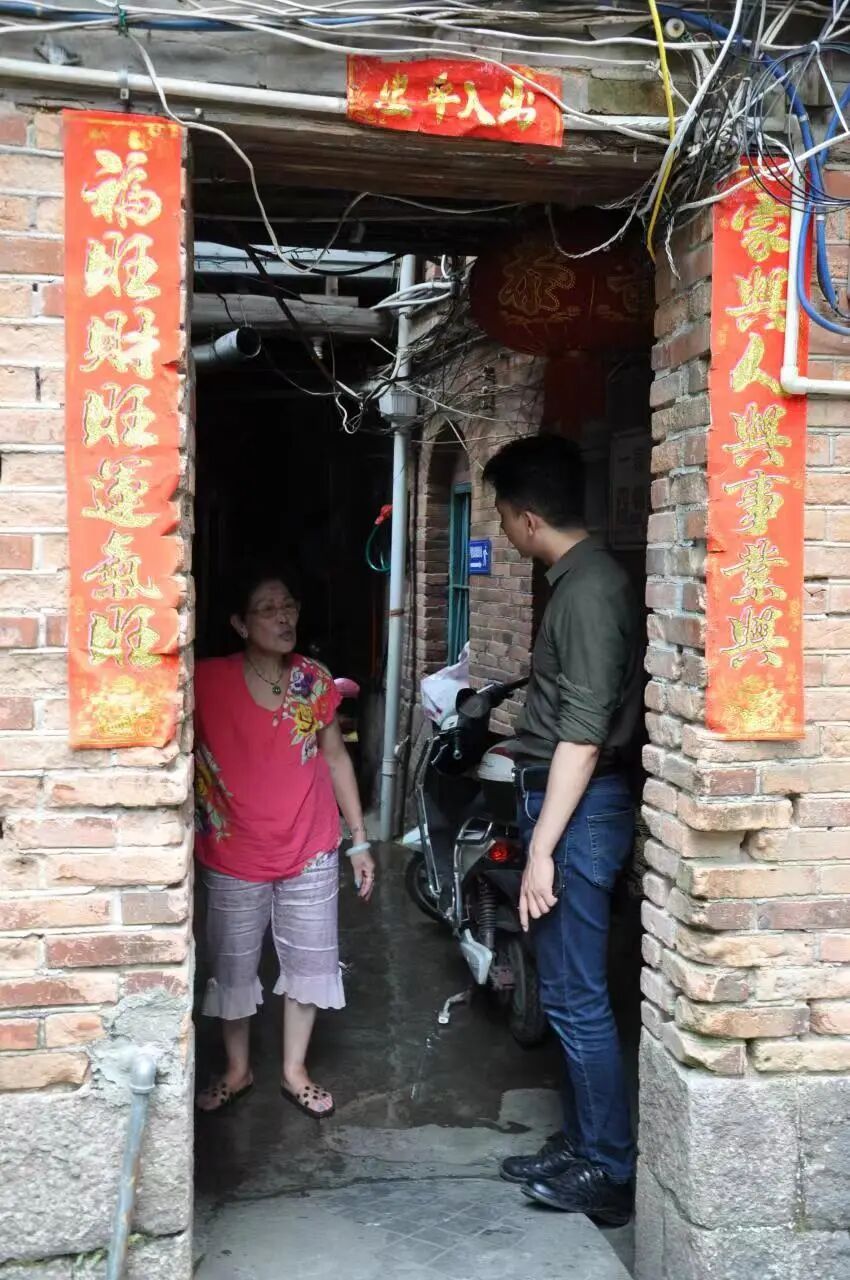
Professor Zhang Jianwei interviewing a resident of Machang Street

Gate of the former Chen Zhilin residence
From August 7th to 9th, we conducted indoor data processing, compiling and analyzing primary materials such as photos, documents, and interview records collected during the fieldwork. Our team brought together multiple disciplinary perspectives including architecture, sociology, history, urban and rural planning, and cultural heritage and museology, sparking continuous exchanges of ideas during discussions.

No. 4 Gongyuan Road
In the final presentation on August 10th, we started with the development phases, functional evolution, and architectural styles of the Yantaishan area, then used character relationships as a medium to build networks of connections among buildings, analyzed the conservation status, protection management, property rights types, and redevelopment of old buildings, and ultimately selected 39 recommended heritage sites in the Yantaishan area, using Machang Street as a case study to propose a sightseeing route.

Machang Street sightseeing route map (drawn by Liu Shuyao)
03 Our Reflections

Participant: Wang Hantao
Fuzhou is my hometown, and I have a genuine interest in the old buildings here and the history behind them, which has also driven me to do some research on modern local architecture. I thought I had a fairly comprehensive understanding of the historical buildings and heritage value of the Cangshan area, but through this workshop, I discovered many long-overlooked details I hadn't noticed before. Because the requirement was to survey the buildings as thoroughly as possible, I saw with my own eyes for the first time many buildings I had only seen in images and documents, which deepened my tangible sense of the architecture. With the help of many friends, I overcame my social anxiety, contacted a descendant of an old building owner, and after some twists and turns, finally gained the trust of an elderly person, which brought forth many wonderful stories. These details not only rippled through my future research ideas but also revealed a more authentic and complex hometown to me.

Participant: Jiang Xi
This Cultural Heritage Conservation Joint Workshop, rooted in heritage studies, connected various disciplines including architecture, sociology, history, and anthropology. As a workshop member from the heritage studies direction, I learned about building structures and styles from architecture students, interview methods from sociology students, and how to filter and organize historical materials from history students... This provided me with a broad knowledge base and new technical approaches for sorting out Fuzhou's heritage resources, extracting heritage value, and exploring value carriers from the perspective of heritage studies. My strongest feeling from this workshop is realizing that heritage studies is an inclusive, open, and dynamic interdisciplinary field.

Participant: Xie Zhi'ang
Paul Claudel described Fuzhou as a city with "the color of roses and honey"—that was my initial sensual perception of Fuzhou. During the detailed investigations of the past few days, this sensual perception became a driving force, prompting me to deepen my intellectual understanding of Fuzhou from all aspects. From the deep courtyards of Sanfang Qixiang to the rows of Western-style buildings on Machang Street, from the scattered consulates on Yantaishan to the summer resort of Guling, from strictly disciplined ancestral halls to distinctively styled church districts… The stories of buildings and people form a long scroll from tradition to modernity, radiating deep charm. Through this workshop, I experienced the enlightenment of cross-disciplinary work and the importance of deeply understanding a region. Cultural heritage conservation will become a desirable research direction influencing my future focus.

Participant: Liu Shuyao
The in-depth investigation and interviews with the residential houses of Cangqian Mountain allowed me to glimpse the microcosm of Fuzhou's modernization. The development and changes in architectural style and the fusion of Chinese and Western elements reflect the transformation of people's living concepts and value systems. The perspective of cultural heritage conservation often sees the big through the small and uses the present to illuminate the past. Through this transformation in thinking, I reacquainted myself with the urban history implicit in the city's architecture and forms.

Observer: Zeng Wei'an
Many thanks to the teachers and senior students for their generous guidance! Collaborating with students from different disciplines, I experienced the collision and complementarity of disciplinary thinking and learned different perspectives for observing the environment. All of us climbed small hills in Fuzhou's forty-degree heat; as long as there was an old building to enter, it didn't seem so hard to bear. When each line of historical record turned into a standing architectural entity, the determination to "protect them" became especially vivid. I really loved Fuzhou's clouds, really loved everyone in the Fuzhou workshop, and really loved Fuzhou's wood, stone, bricks, and tiles.

Academic Teaching Assistant: Zhou Qiutong
Yantaishan is very small—so small that you can walk through the entire neighborhood in a few hours. Yantaishan is also very large—large enough to simultaneously absorb the great waves of the era and embrace both Chinese and Western cultures. Its unique blend of qualities made me feel the inclusiveness, openness, and diversity of Fuzhou culture. The brilliance of history lies in its tangible warmth and emotional resonance with place: every brick, every tile, every person, every scene is a medium that triggers deep-seated connections. Because of the workshop, I had the opportunity to research Yantaishan in depth with students from different disciplinary backgrounds, bringing diverse perspectives together to construct our own historical narrative. In just a few days, using Yantaishan as a window, I came to know Fuzhou and its history; and using the workshop as a starting point, I experienced interdisciplinary integration and understood cultural heritage.

Group photo of the Yantaishan team in front of Shicuo Church
uan Road, Haidian District, Beijing