Sanfang Qixiang Research Group
Wang Siyu
Teacher's Message
From the perspective of heritage studies, the work of the Sanfang Qixiang group primarily addressed two questions: what is the heritage value of Sanfang Qixiang (especially when viewed through the lens of the dawn of modern enlightenment), and what is the current conservation status of Sanfang Qixiang (which includes both the physical fabric and the system of conservation and utilisation). To better answer these two questions, this workshop focused on Sanfang Qixiang by conducting a review of its historical and geographical evolution, on-site surveys and documentation of building conditions, oral history interviews with descendants of prominent families, and interviews with conservation management stakeholders. Through this process, students learned how to approach such a heritage object within a multidisciplinary and comprehensive framework. Students from different disciplines also observed and learned from each other's disciplinary perspectives, continuously expanding their understanding of what constitutes heritage.

Group Introduction
Members of the Sanfang Qixiang group included students Wu Lantuya, Liu Yuxin, Xue Yali, Jiao Jingran; supervising teacher Wang Siyu; invited teacher Zhang Jizhou; observer Wang Xiaoxi; and academic teaching assistant Huang Kang. During the ten-day research period, the group entered Sanfang Qixiang, explored its history, touched its texture, and felt the first pulse of the ancient traditional context in the dawn of modernity, providing comprehensive investigative support for heritage value research.
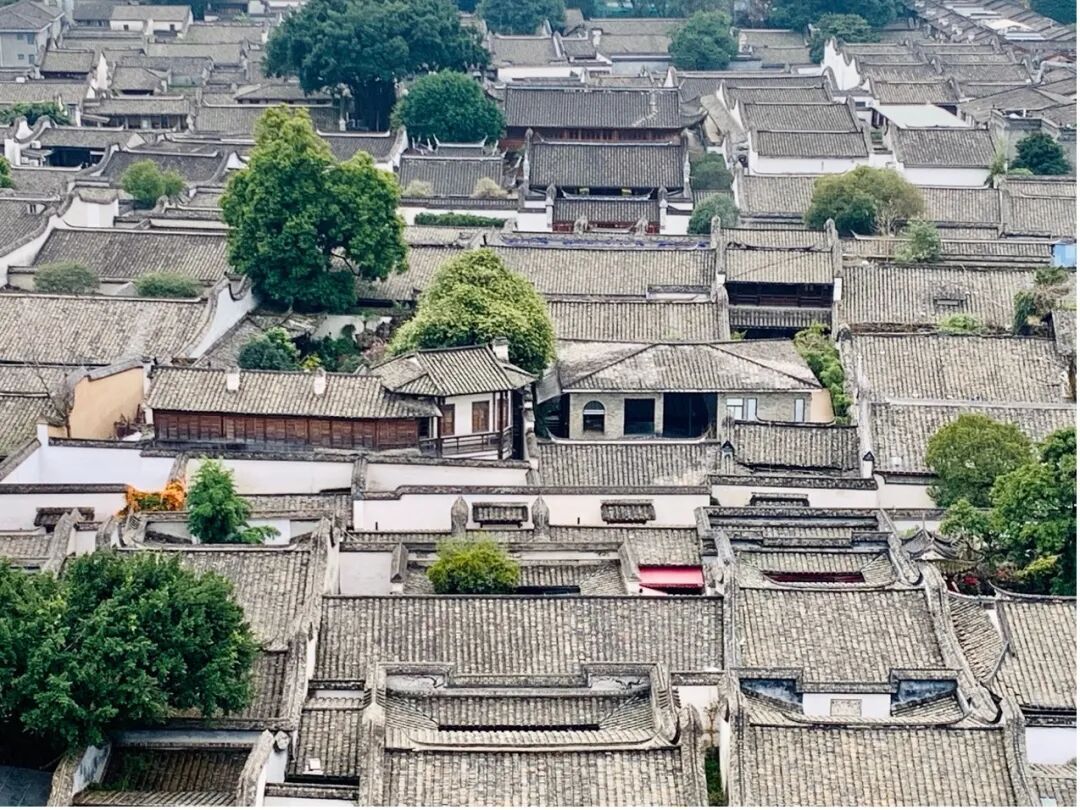
Aerial view of Sanfang Qixiang
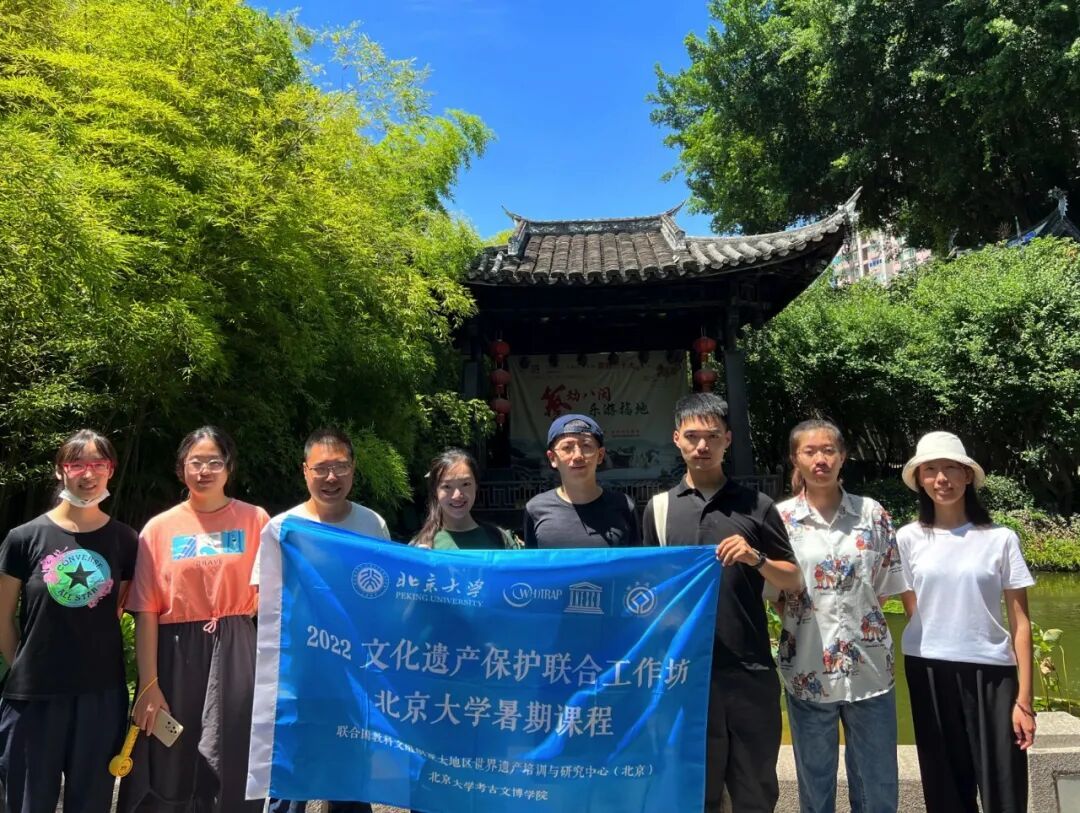
Sanfang Qixiang group photo inside the Lin Zexu Memorial Hall
Work Summary
August 3–4 constituted the group's intensive survey phase, focusing on systematically understanding the classic heritage sites and their conditions within Sanfang Qixiang within a limited time. To this end, invited teacher Zhang Jizhou had carefully selected a number of heritage sites in advance. Under the guidance of the teachers, the group conducted comprehensive documentation of buildings, going through each courtyard one by one.

First day of survey, August 3 and On-site photography with clear division of labor

Students, led by teacher Zhang Jizhou, walking through surrounding streets and temples to experience the local cultural atmosphere
"Reading a thousand postscripts is not as good as a single glance at the original painting—the principle is clear enough. Applying this principle to the study of architecture is the way to find the door." The in-depth on-site observation, accompanied by teacher Zhang Jizhou's explanations, became increasingly vivid and profound. Over two days, the students conducted in-depth surveys of more than twenty residential buildings, walked through all the streets and lanes of Sanfang Qixiang, gained extensive knowledge of ancient architecture, and continuously felt the warmth of Fuzhou's hospitality under temperatures approaching 40 degrees Celsius.

Group photo atop Xiaohuanglou
August 5–7, the group conducted research along three parallel tracks.
The Heritage Research and Assessment track was responsible for data organization and supplementary surveys. Aligned with the workshop's theme of "the dawn of modern enlightenment," students conducted further research on buildings related to important historical events and figures from modern history.

Tingyu Studio (left) and Xie Ancestral Hall (right), which witnessed important events such as modern literary activities
and the May Fourth Movement, respectively
The Interviews with Important Figures and Families track visited multiple descendants of local families. Through on-site surveys, they experienced the continuity of folk culture within Sanfang Qixiang and the interaction between people and space, while also gaining a visceral sense, through the oral accounts of local residents, of the small histories of the era condensed within individuals.

Attending a gathering of descendants of prominent figures from Fujian Shipbuilding (left)
Conducting an interview inside the former residence of Sa Zhenbing (right)
The Conservation, Management, and Utilization track split into several teams to interview various stakeholders in the existing conservation system of Sanfang Qixiang. They conducted "street sweeping" activities within the lanes and alleys, specifically documenting the conservation and utilization status of each household.
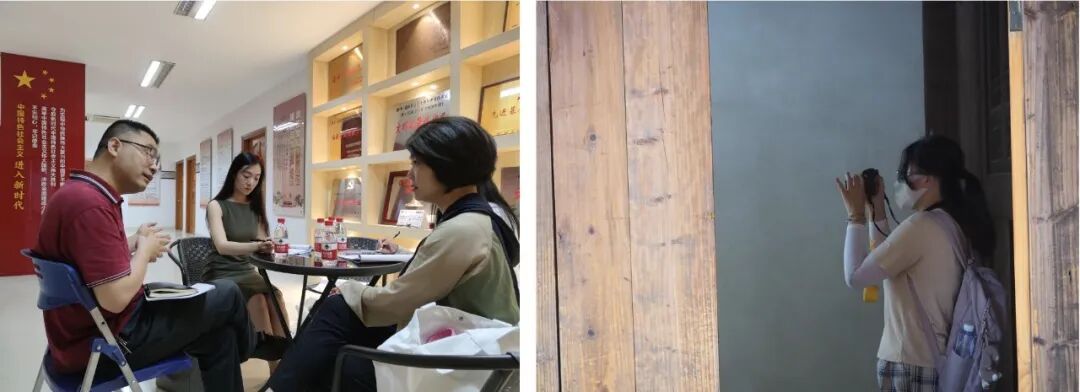
Group students conducting interviews (left)
Group students photographing during street sweeping (right)
August 8–9 was the phase of indoor data organization and refinement. The students conducted in-depth analysis of the preliminary survey results. Focusing on the shared theme of "the dawn of modern enlightenment," they divided their work. Students from architecture-related disciplines performed in-depth analysis and assessment of the physical remains, producing professional diagrams; students specializing in literature and anthropology focused on historical figures and interview research. Through studying the social life picture of the lanes and alleys, they arrived at two incisive conclusions: "the loss of a lively, lived-in atmosphere within the lanes" and "the 'reinvention' of tradition." Students specializing in museum studies and cultural industries proposed recommendations concerning issues in the overall conservation and utilization status of the lanes. Although their work emphasized different areas, they all focused on the same object, revolved around the same theme, and communicated closely during the work, deeply experiencing the thinking methods of different disciplines.

Indoor work and meetings
August 10, the group presented a comprehensive report on the above outcomes, successfully completing the offline portion of the workshop, and received their workshop completion certificates just before midnight.

Group presentation slides

Students presenting on site

The "graduating at midnight" group of four, plus the teaching assistant who didn't graduate
Summaries and Reflections

Student Xue Yali
I greatly benefited from this research activity. Although each of us could work more efficiently by returning to our own professional fields for more targeted tasks, I cherished the time when our group members were together. It was easy to see that people from different professional backgrounds thought very differently when looking at the same thing. Through ample interaction, exchange, and discussion, we complemented each other. Even when we didn't reach consensus, we broadened the possibilities of our thinking. Breaking down disciplinary boundaries and transcending one's own mental patterns—I believe this is precisely the meaning of a joint workshop.
The ten-day field research has ended. Unfortunately, due to a foot injury, I was unable to visit the former residences of famous figures in Sanfang Qixiang with my group mates, which I regret. However, being able to do some data collection and organization for the group indoors also improved my learning skills and expanded my knowledge. What impressed me most during this research was that the interaction among students from multidisciplinary backgrounds inspired each other, enriching the angles of research and deepening its content. This is perhaps the advantage and charm of having students from different disciplinary backgrounds complete a project together. Finally, I want to express my affection for my group members, Teaching Assistant Huang Kang, and the two teachers. Thank you all for taking care of me during the research. I hope we can gather again soon and stay in touch!
Student Jiao Jingran
Through this workshop, I had the opportunity to visit various historical buildings, gaining a more intuitive sense of domestic houses, boundary temples, Taoist temples, ancestral halls, and churches in the southeastern region. I was amazed by the inclusiveness of Fuzhou. During group discussions, I also supplemented my knowledge of architecture, gardens, heritage conservation, and community museums. More importantly, I recognized the limitations of my own approach to understanding local "culture"—my tendency to seek only a narratable understanding of "the Other." The emphasis that architecture and history disciplines place on "materiality" and the way of obtaining information through interpreting "objects" provided new stimulation for me.
Student Wu Lantuya
As a novice in cultural heritage knowledge, I gained a lot from the workshop. Through online and offline lectures, I learned from various teachers about research methods in urban history, the application of big data and facial recognition in family genealogy, community museology, and more. But what I remember most is surveying Sanfang Qixiang with my group members—it was painful but joyful. As a literature student accustomed to spending long hours reading in the library, I participated in "fieldwork" for the first time in my life. I still recall that on the first day of observing the famous residences in Sanfang Qixiang, when the teaching assistant asked us to observe elements such as foundations, columns, and roof trusses, I was utterly disoriented inside the buildings, only able to feel that this was an old house and that the carvings were quite beautiful. But under the guidance of Teacher Zhang Jizhou and Teaching Assistant Huang Kang, I was able to keep up with the group's pace in the following days and deeply appreciate the essence of an ancient building. Finally, I want to express my love for the dearest teachers, teaching assistant, and teammates of the Sanfang Qixiang group, and thank my roommate Xue Yali for accompanying me through so many days and nights.

Student Liu Yuxin
During the ten-day research activity, each group discussion made me appreciate the charm of interdisciplinary work. I learned how to observe and document an ancient building with Teacher Zhang Jizhou and Teaching Assistant Huang Kang; listened to Liu Yuxin and Wu Lantuya share their oral history stories with descendants of prominent families; counted shops with Xue Yali under 40-degree heat outdoors... Under Professor Wang's guidance, disciplines such as architecture, anthropology, history, and museology collided within Sanfang Qixiang. I look forward to offering new interpretations of these lanes and alleys.
Observer Wang Xiaoxi
My complex feelings for Sanfang Qixiang date back 30 years. Fifteen years ago, with the disappearance of No. 18 Wenrufang, the Sanfang Qixiang life of my childhood memories also vanished. Admittedly, many people feel that Sanfang Qixiang today has been completely renewed; I used to think so too. But later I understood that the many surviving Ming Dynasty structures and garden pavilions here constitute a depth that few similar old districts elsewhere can match. With this excellent opportunity, I was able to enter these buildings with all my new friends, climb rockeries and drill through snow caves, and appreciate the profound beauty of Sanfang Qixiang. The summer heat was intense, time was short, and although there was regret that our observations were limited, what my eyes could see was enough to outline the former splendor of Sanfang Qixiang. I have read many materials and visited many residences, yet I still look forward to the students' examination of Sanfang Qixiang with an "outsider's" perspective—this, too, can be considered my "rereading" of Sanfang Qixiang after 30 years.

Invited Teacher Zhang Jizhou
Teaching Assistant Huang Kang
Zeng Gong, a scholar of the Song Dynasty, once described Fuzhou: "The mountains have many towering trees, and the craftsmen are highly skilled. People take pride in the grandeur and beauty of their houses; even the poor must have a fine dwelling." This workshop confirmed the truth of these words. Accompanied by teachers and fellow students, I was able to survey a large number of pavilions, towers, garden halls, and studios within Sanfang Qixiang. The process was full of delightful surprises and refreshing discoveries. At the same time, focusing on the workshop's theme, our group's teachers and students from different disciplines cooperated and worked together. Beyond the surprises from the research subjects themselves, everyone continuously broke through their own mental paradigms through repeated exchanges and collaborations, experiencing the pedagogical charm of the workshop. As a teaching assistant, my main task was to provide various forms of support. Over ten days, together with everyone, we achieved successful offline results and formed deep friendships. I look forward to meeting everyone again and revisiting Fuzhou!