Opening Ceremony

◮ Fig. 1: Group photo at the opening ceremony
Abstract
On July 31, 2020, the “2020 Huangguoshu Tunpu Survey and Joint Workshop on Cultural Heritage Conservation” officially opened in Anshun City, Guizhou Province. This workshop was jointly organized by the World Heritage Institute of Training and Research for the Asia and the Pacific Region Under the Auspices of UNESCO (Beijing), hereinafter referred to as WHITR-AP Beijing; the School of Archaeology and Museology at Peking University; and the School of Architecture and Landscape Architecture at Peking University. It was supported by the Anshun City World Heritage Nomination Office, Anshun University, and the Institute of History of Science and Cultural Heritage at the University of Science and Technology Beijing, and generously funded by the Tianhe Public Welfare Foundation.
Spanning three weeks, the workshop brought together more than ten experts and scholars from diverse disciplinary backgrounds at Peking University, Harvard University, the University of Science and Technology Beijing, and Anshun University, along with 26 students from Peking University and Harvard University, and a group of teenagers from the ecological education team organized by the Tianhe Public Welfare Foundation.
Setting Off
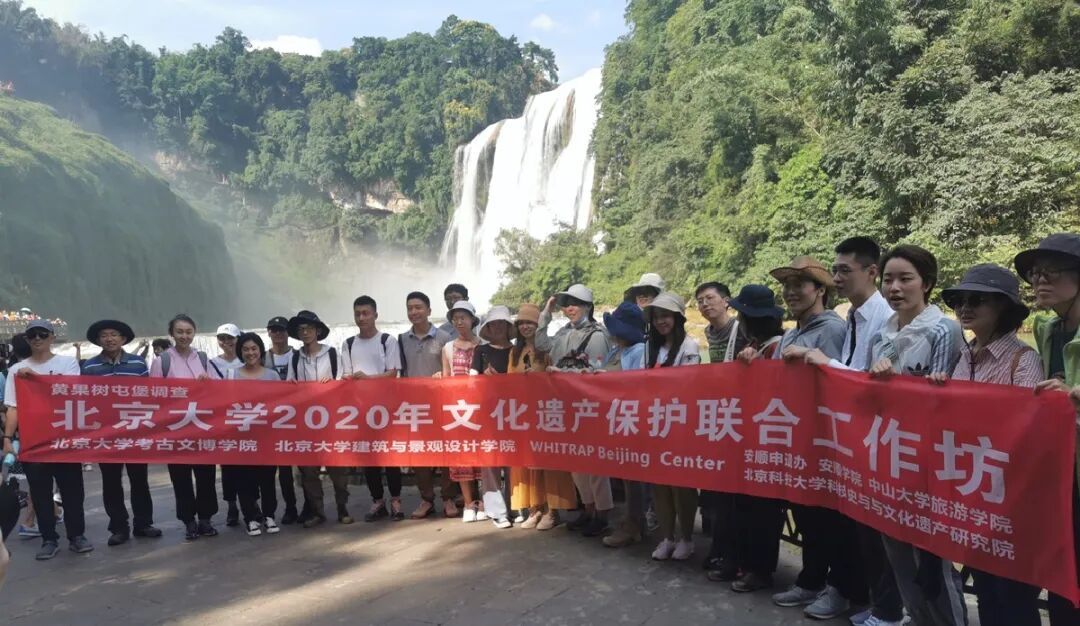
◮ Fig. 2: Group photo at Huangguoshu Waterfall
Amid the ongoing pandemic prevention and control measures, following thorough and meticulous preparatory work, more than 40 teachers and students finally overcame numerous challenges and arrived in Anshun City, Guizhou Province, on July 29. This marked the official launch of the Huangguoshu Tunpu Survey and Cultural Heritage Protection Joint Workshop. On July 30, guided by the Huangguoshu Scenic Area Management Committee, all faculty and students visited famous attractions such as the Huangguoshu Grand Waterfall and Tianxingqiao Scenic Area, experiencing the rich and beautiful natural heritage resources of the Huangguoshu region.
Official Opening

◮ Fig. 3: Panoramic view of the opening ceremony
On July 31, the workshop’s opening ceremony was officially held at the Huangguoshu Scenic Area Management Committee. The ceremony was presided over by Ms. Liu Ying, Deputy Director of the Anshun City World Heritage Nomination Leading Group Office.
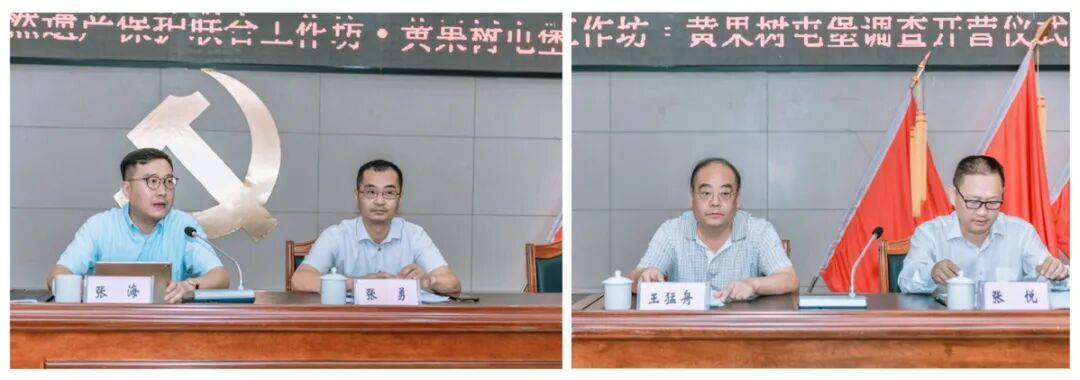
◮ Fig. 4: Zhang Hai and Zhang Yong delivering remarks
◮ Fig. 5: Wang Mengzhou and Zhang Yue delivering remarks
At the opening ceremony, Zhang Yue, Secretary of the Party Working Committee of the Huangguoshu Tourism Area, introduced the background of the Huangguoshu Tunpu World Heritage nomination, its natural and cultural resources, and the region’s major intangible cultural heritage.
Wang Mengzhou, Deputy Director of the Anshun Municipal People’s Congress Standing Committee, explained the significance of natural and cultural heritage protection for regional economic development from the perspective of the “Two Mountains Theory,” emphasizing that ecological civilization construction must prioritize protection—only by safeguarding “clear waters and lush mountains” can we secure “mountains of gold and silver.”
Zhang Hai, Secretary-General of the Tianhe Public Welfare Foundation—the funding organization for this workshop—pointed out that while the objects of protection are tangible cultural heritage, the emphasis lies on intangible cultural heritage. He stressed that economic development must always prioritize the protection of natural and cultural heritage, and introduced the founding mission of the Tianhe Public Welfare Foundation, which is to inspire young people to learn about cultural and natural heritage.
In his opening remarks, Zhang Yong, Director of the Guizhou Provincial Bureau of Cultural Relics, provided an overview of the province’s existing cultural heritage. He noted that the ultimate goal of this survey is to produce an academic report supporting the World Heritage nomination of the Huangguoshu Tunpu. He expressed hope that the nomination process would proceed smoothly and ultimately succeed, while also promoting the protection of cultural landscapes and natural heritage in the Anshun region and fostering the development of all-for-one tourism.
Zhang Jianwei, Deputy Dean of the School of Archaeology and Museology at Peking University, delivered a speech introducing the background of this workshop and the relevant research arrangements, as well as the mission of WHITR-AP Beijing and its practices in multidisciplinary heritage conservation.
Finally, Professor Sun Hua from the School of Archaeology and Museology at Peking University presented the major achievements of Guizhou’s archaeological work and cultural heritage conservation. He expressed hope that the faculty and students with diverse disciplinary backgrounds participating in this workshop would spark academic inspiration and successfully complete the baseline survey of heritage resources.

◮ Fig. 6: Group photo of Zhang Jianwei, Zhang Yong, and Li Dihua
Opening Ceremony and Mobilization

◮ Fig. 7: Speakers at the mobilization session
Following the opening ceremony, a representative from the faculty delivered a motivational address to the workshop participants. The session was chaired by Li Kuanghan, Assistant Director of WHITR-AP Beijing. Li Dihua, Vice Dean of the School of Architecture and Landscape Architecture at Peking University, provided an overview of the historical and cultural context of the Guizhou region. He highlighted the significance of the World Heritage nomination process for the protection and development of Guizhou’s natural and cultural heritage, and called on all sectors to contribute to the development of Guizhou’s rich heritage resources. Immediately following, Professor Lü Yanping, Secretary-General of the Guizhou Tunpu Research Association, introduced the local customs and traditions of the Tunpu people, emphasizing that the Huangguoshu Natural Heritage Site and Tunpu culture serve as vital historical testimonies of Guizhou. Finally, Zhao Yajing, a doctoral student at Peking University’s School of Archaeology and Museology, and Kuang Yudanling, a student representative from the ecological education group organized by the Tianhe Public Welfare Foundation, delivered remarks on behalf of the students.
Field Research and Training

◮ Fig. 8: Lü Yanping delivering a lecture
That afternoon, several professors delivered lectures on various specialized topics. Professor Lü Yanping from Anshun University discussed Tunpu culture in Anshun, covering the historical background of the Tunpu migration, the concept of Tunpu, the origins of the Tunpu people, the formation of Tunpu culture, and existing Tunpu customs and traditions. Li Dihua, Vice Dean of the School of Architecture and Landscape Architecture at Peking University, shared experiences and methods for field surveys, providing specific requirements for written documentation and photography. Zhang Jianwei, Vice Dean of the School of Archaeology and Museology at Peking University, introduced experiences and methods for surveying historic buildings, outlining specific research methods and surveying principles, and illustrating how the significance of field surveys lies in extracting cultural information and value from physical structures.
Conclusion - Exploring Possibilities
Over the next three weeks, the workshop will be divided into four groups—Tunpu, village settlements, ancient trails, and cultural relics and historic sites—to conduct field surveys and architectural inspections. Based on this work, participants will conduct research on the interrelationship between cultural and natural value elements, ultimately compiling a report and presenting their findings. The workshop aims to employ interdisciplinary and integrated approaches to investigate and study the basic conditions of cultural heritage in the Huangguoshu region, thereby providing solid and reliable foundational data and research findings to advance the conservation, utilization, and World Heritage nomination of the Huangguoshu Tunpu landscape, as well as to explore feasible pathways.
Organizing Units
Hosting Organizations
World Heritage Institute of Training and Research for the Asia and the Pacific Region Under the Auspices of UNESCO (Beijing) (WHITR-AP Beijing)
School of Archaeology and Museology, Peking University
School of Architecture and Landscape Architecture, Peking University
Supporting Organizations
Anshun City World Heritage Nomination Office
Anshun University
Institute of History of Science and Cultural Heritage, University of Science and Technology Beijing
Funding Organization
Tianhe Public Welfare Foundation
Workshop Staff
Overall Coordinator
Sun Hua School of Archaeology and Museology, Peking University
Research Leaders
Li Dihua School of Architecture and Landscape Architecture, Peking University
Zhang Jianwei School of Archaeology and Museology, Peking University
Instructor
Chen Yaohua School of Urban and Environmental Sciences, Peking University
Team Leaders
Tunpu Group
Li Kuanghan WHITR-AP Beijing
Lü Yanping Anshun University
Village Group
Wang Siyu School of Archaeology and Museology, Peking University
Li Wanxin School of Archaeology and Museology, Peking University
Lu Hao School of Archaeology and Museology, Peking University
Ancient Trails Group
Wang Yuchen Institute of History of Science and Technology and Cultural Heritage, University of Science and Technology Beijing
Zhang Baoqing School of Archaeology and Museology, Peking University
Cultural Relics and Historic Sites Group
Zhang Jianwei School of Archaeology and Museology, Peking University
Shang Jinyu School of Archaeology and Museology, Peking University
Article Editor
Zhang Guanqi School of Archaeology and Museology, Peking University
Luo Kerui School of Architecture and Landscape Architecture, Peking University
Article Reviewer
Li Kuanghan WHITR-AP Beijing
Zhang Jianwei School of Archaeology and Museology, Peking University
Photography
Hu Yu Anshun City World Heritage Nomination Office