In July, the WHITRAP Beijing Center organized the 8th Youth Heritage Salon, visiting multiple heritage sites in Quanzhou city and its rural areas, including many sites of the world heritage “Quanzhou: Emporium of the World in Song-Yuan China,” as well as surrounding towns such as Xiaozuo and Anxi. On the basis of fieldwork, interdisciplinary dialogues on heritage issues were held among archaeology, anthropology, architecture and urban planning. As one of the participants, I would like to use this article to record and reflect on the trip and discussions. I should note that although I can barely count as a heritage researcher, this was my first time in Quanzhou, and I lack deep knowledge of Quanzhou studies. What follows is merely my personal perception based on my own experience and limited professional background, as a response to the salon introducers and organizers.

1. Outstanding Universal Value – World Heritage as an Interpretive Framework for Value
Possessing Outstanding Universal Value (OUV) is a prerequisite for inscription as a world heritage site. Although this concept has received much criticism from academia, it is undeniable that OUV has become the official discourse for interpreting heritage. According to the UNESCO website, with its rich and diverse archaeological remains, artifacts, and relics from the Song-Yuan period, Quanzhou demonstrates the “vitality of the world’s maritime trading center and its close links with the Chinese hinterland” in the 10th–14th centuries, meeting criterion (iv): “to be an outstanding example of a type of building, architectural or technological ensemble or landscape which illustrates (a) significant stage(s) in human history.”
Anyone who has visited Quanzhou or knows a little about the city understands that its historical value is by no means limited to the Song-Yuan period. The Ming and Qing dynasties, and even modernization, have left their marks on this ancient city, and the contemporary transmission of its folk culture is a source of pride for locals. For the moment, let us not argue whether the OUV of a world heritage site can fully represent all of Quanzhou. Instead, let us first consider whether the 22 component sites of this world heritage property clearly convey the OUV discourse system – or at least this value theme – to visitors.
At many heritage sites, public interpretation of heritage value is often a combination of museum exhibitions and on‑site displays. Quanzhou’s world heritage is no exception. The Quanzhou Maritime Museum houses a comprehensive exhibition on Quanzhou’s inscription, presenting the history of Zayton (Quanzhou), trade artifacts, management systems, and diverse society, linking the physical remains of the various component sites. It recreates the urban and regional conditions of Song-Yuan Quanzhou, forming a vivid and complete value narrative. This exhibition should be recommended as the first stop for visitors to the world heritage site, providing a macro view of the entire property through its component sites, followed by visits to individual sites to deepen understanding. However, it seems that this public OUV interpretation has only done the first step; the second step still needs improvement.
I have not visited all 22 component sites, so my discussion is based on my limited experience. The Quanzhou Prefecture Confucian Temple and School is one of the heritage sites within Quanzhou city. It is also a National Key Cultural Relics Protection Unit. Its main existing buildings date from the Song (Dacheng Hall), Yuan (Pan Bridge), Ming, Qing, and later periods. The eastern wing currently hosts an exhibition on Quanzhou’s urban situation, and the western wing hosts an exhibition on the history, rituals, and architectural features of the Confucian temple. These exhibitions focus on architectural form and craftsmanship, reflecting the value criteria of ancient architectural heritage protection units. They hardly show how the Confucian temple supports the OUV significance of Quanzhou as a world maritime trade center in the Song-Yuan period. Compared with the narrative of world heritage OUV, the professional discourse of heritage protection units has not been well translated into popular language, which is not visitor‑friendly for understanding the heritage value.
The Qingyang Xiacaopu Iron Smelting Site is an archaeological site from the Song-Yuan period located outside Quanzhou city in Anxi County. Archaeological excavation is still ongoing. A site display area and indoor exhibition hall have been built. This iron smelting site representatively demonstrates the regional linkages between Quanzhou and its surrounding urban and rural areas in production, transportation, and trade during the Song-Yuan period. The exhibition hall explains the local mineral resources, Song-Yuan iron smelting techniques, and their relationship with Quanzhou’s transport and trade networks. Obviously, compared to the Confucian Temple, which was listed as a national heritage protection unit in 2001 and remains bound to the discourse framework of heritage protection units, the Xiacaopu site, where excavation officially began in 2019, is more aligned with the world heritage OUV value interpretation. However, as an archaeological site, if it could incorporate basic archaeological knowledge and reasoning logic into the display, it might be more effective in building visitor interest in the site and the world heritage property as a whole.
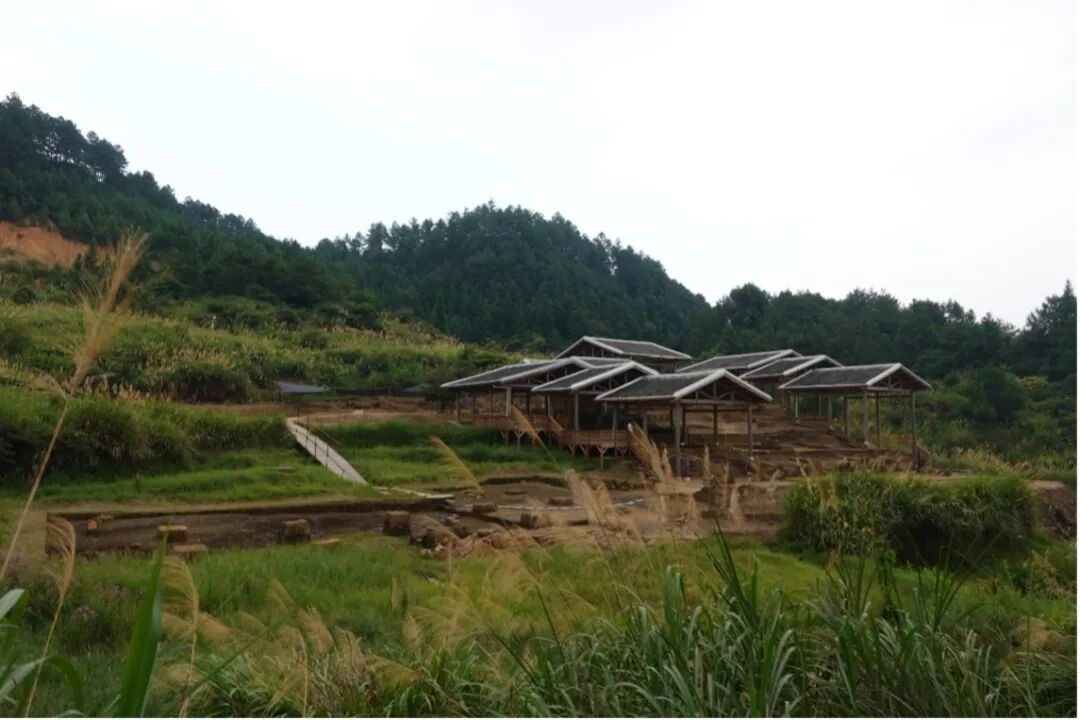
Xiacaopu Site
2. Beyond OUV – Historical Layering from Song-Yuan Archaeology to Contemporary Practice
Although Quanzhou’s world heritage sites vary in how prominently they highlight OUV, it is indeed becoming an increasingly authoritative mainstream discourse. The focus on the Song-Yuan period seems to be gradually overshadowing attention to other historical periods and even contemporary cultural practices and value interpretations, causing some anxiety among local scholars (as Luo Pan put it). Must our interpretation of heritage value be confined to the specific historical period designated by OUV? And must our presentation of a city’s history be limited to officially recognized heritage?
The Qingjing Mosque was first built in the Song dynasty and is the only mosque among Quanzhou’s 22 world heritage sites. Interestingly, the mosque contains three groups of prayer buildings from different periods: the Fengtian Altar (connected to the gate tower) from the Song-Yuan period, though only stone pillars and walls remain, still shows typical 11th‑century Islamic architectural style; the Mingshan Hall, first built in the Ming dynasty and restored in modern times, adopts the traditional Chinese timber courtyard form; and the new prayer hall, funded by the Sultan of Oman in 2008 and completed in 2009, uses modern structural techniques combined with traditional Islamic elements. Its complex of prayer hall, bathhouse, and library reflects the communal tradition of Islamic religious architecture. These three buildings present the appearance of prayer spaces from different periods, demonstrating the diachronic development of Islamic culture and community in Quanzhou. Any visitor to the Qingjing Mosque would surely not regard it merely as a Song-Yuan relic, but as a cultural heritage accumulated through historical layering. Its value far exceeds the OUV’s focus on a specific period.
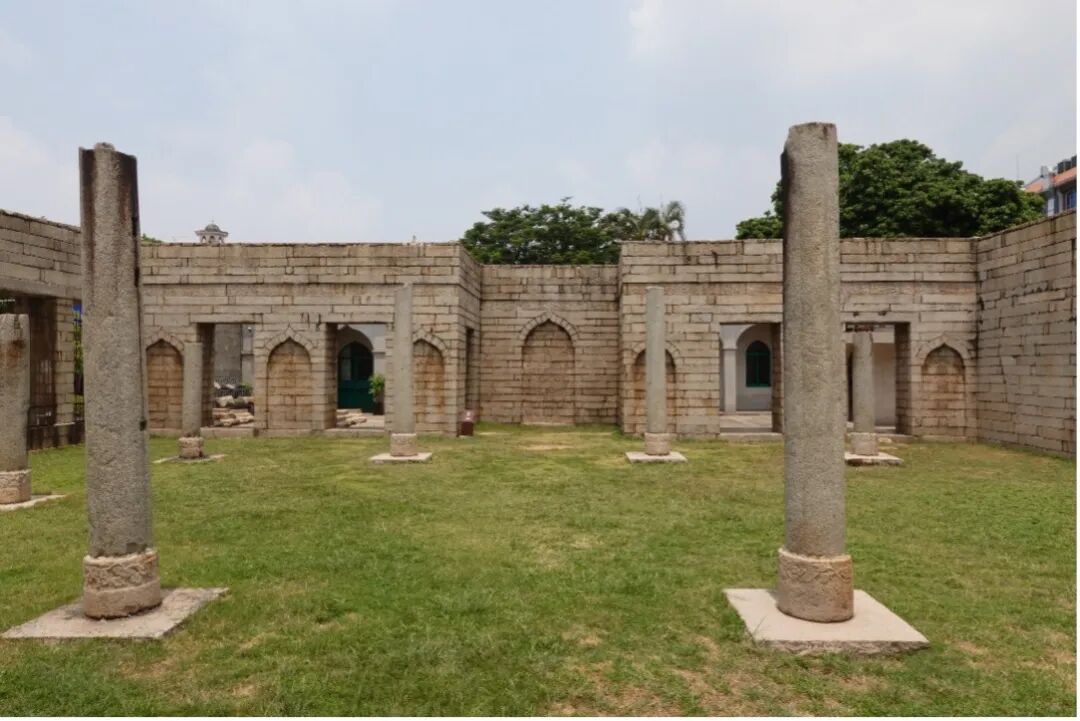
Qingjing Mosque – Fengtian Altar

Qingjing Mosque – Mingshan Hall

Qingjing Mosque – New Prayer Hall
This historical layering is not limited to world heritage sites. The spatial fabric and architectural forms of different areas within the old city of Quanzhou also express the city’s contemporary development trajectory. East of the Qingjing Mosque is the Tonghuai Guanyue Temple, a “Guandi Temple” first built in the Song and rebuilt in the Republican period. It has long been the most important temple in the area. Although it is not a world heritage site, that has not diminished local people’s regard for it. At the northwest corner of the block where the Qingjing Mosque and Guanyue Temple are located stands the Quanzhou Workers’ Cultural Palace, built in 1953. Nearby are public buildings and spaces such as a library, art museum, and city park. One can imagine that this was once a core cultural area of Quanzhou. On Jinsheng Road, on the east side of the block, at its intersection with Tumen Street, a concrete archway for the tourist culture street still stands, creating, together with small shops on both sides, a local residents’ market, and somewhat dilapidated residential buildings, an atmosphere of the 1980s-90s. It reminds me of Beijing’s Longfosi around the year 2000 – a deliberately created tourist street gradually marginalized by the times, returning to being a space for local life.

Tonghuai Guanyue Temple

The former tourist culture street
For current visitors to Quanzhou, the more familiar areas are probably the snack street on West Street in front of Kaiyuan Temple and the arcade buildings on both sides of Zhongshan Road Pedestrian Street. From my personal experience: a taxi driver who didn’t know the city recommended the newly renovated Zhongshan Road; the hotel front desk suggested West Street for affordable snacks; but my genuine Quanzhou friend insisted on exploring the small alleys between the two. These three areas were developed in different periods, follow different models, and show different historical district development paths under their specific circumstances. West Street is one of Quanzhou’s oldest streets. Its snack street reputation seems to have existed for a long time. Shops line both sides, and the neon lights at night attract everyone’s eyes, while the historical buildings behind are ignored. You might call it Quanzhou’s Nanluoguxiang or Kuanzhai Alley.

West Street
Compared with the mature snack street on West Street, Zhongshan Road and its side alleys are in the midst of intensive “development.” Not only are there construction sites for “building renovation” everywhere, but many shops haven’t yet opened. Zhongshan Road is a major urban thoroughfare developed in the 1920s in Quanzhou. On both sides are two‑ or three‑story modern buildings of various styles, with recessed verandas on the ground floor forming continuous arcades. These buildings include former economic and cultural landmarks such as the “Private Haijiang Academic Reference Room,” “Great Shanghai Barbershop,” and “Democratic Cotton Cloth Store.” Their nameplates remain on the facades, showing the “documentary” value of historic buildings. However, aside from that, it is hard to feel Quanzhou’s modern history from these arcade buildings. Although the renovation work has not erased the diversity of styles and decorative elements, the new facades and uniform scale give off a hint of rigidity – after seeing one building, you can imagine the entire street. More frustrating, probably due to location land values, the existing shops in these modern arcades have almost nothing to do with Quanzhou’s history and culture, much like Dashilan in Beijing, which is filled with international brands.
The small alleys on both sides of Zhongshan Road are much richer. There are traditional grand mansions (da cuo), pavilion‑territory temples, as well as modern houses and schools. However, any building with a modicum of historical or cultural value seems to have been targeted by “heritage” under the banner of “shared by all humanity,” being transformed from private or community ownership into “public” heritage through renovation. One can imagine that with the influx of capital and tourism development, the “guardians of the grand mansions” who live in those traditional houses will eventually be disturbed to the point of moving away. What will happen to the buildings once their owners are gone? The former residence of Su Tingyu, renovated into a cultural performance venue, suggests one possibility. Middle‑class gentry can drink tea and watch puppet shows there, and passing tourists can also stand to watch. Perhaps the development model of “clubs” and “boutique hotels” in the lanes off the main street of Sanfang Qixiang (Three Lanes and Seven Alleys) in Fuzhou is the future of this area. The difference is that Quanzhou, after becoming a world heritage site, has discovered its economic potential and started a new round of development, whereas Fuzhou made its renovations and then tried to apply for world heritage status.

Side alleys off Zhongshan Road

Zhongshan Road
3. A Brief Summary
Since I had never been to Quanzhou before, my understanding of the changes before and after its world heritage inscription is limited. Much of the above is based on my subjective impressions and conjectures. Still, various signs indicate that the world heritage title has indeed become a new city brand, using archaeological professional discourse to establish Quanzhou’s importance in a specific historical period. As Minister Chen Qingzong said, world heritage is a means, not an end. The OUV narrative framework can be one way to interpret heritage value for the public, but the potential value of heritage is by no means limited to this. The urban changes triggered by the heritage title are not all positive, nor are they necessarily all negative. I believe that wise Quanzhou people will actively “use” the heritage title and the changes it brings to their own benefit. Mr. Chen Jianguo, who has run the Zhenhao Jia tea drink shop on Nanjun Road for over twenty years, opened a larger new shop last year in Huaxiang, west of Zhongshan Road. In his old shop of just over ten square meters, he skillfully serves customers and promotes his new shop. For him, the development of the historic district is a new opportunity to expand his family business. Quanzhou’s inscription as a world heritage site also gives him a chance to re‑establish the historical status of Quanzhou cuisine in the southern Fujian region, using it to mock Xiamen’s modern “new money” image.

Zhenhao Jia tea drink shop
The power of the world heritage title is necessarily limited. In urban and rural areas outside the world heritage sites, without the “burden of history,” there is no need to build and develop with hesitation. Whether it is Xiaozuo’s art gallery converted from an old factory, the ecological improvement of the forest farm, the new coastal landscape created by wind turbines, or Anxi’s industrialization of traditional tea production and the construction of new industrial parks, all show multiple possibilities for contemporary practice in mountain and coastal areas. To have nothing to do with heritage might actually be a kind of luck.

Xiaozuo Windmill Island
Author: Zhao Xiaomei – Associate Professor, Department of Cultural Heritage and Museology, Fudan University
Images: All taken by the author during this field trip